
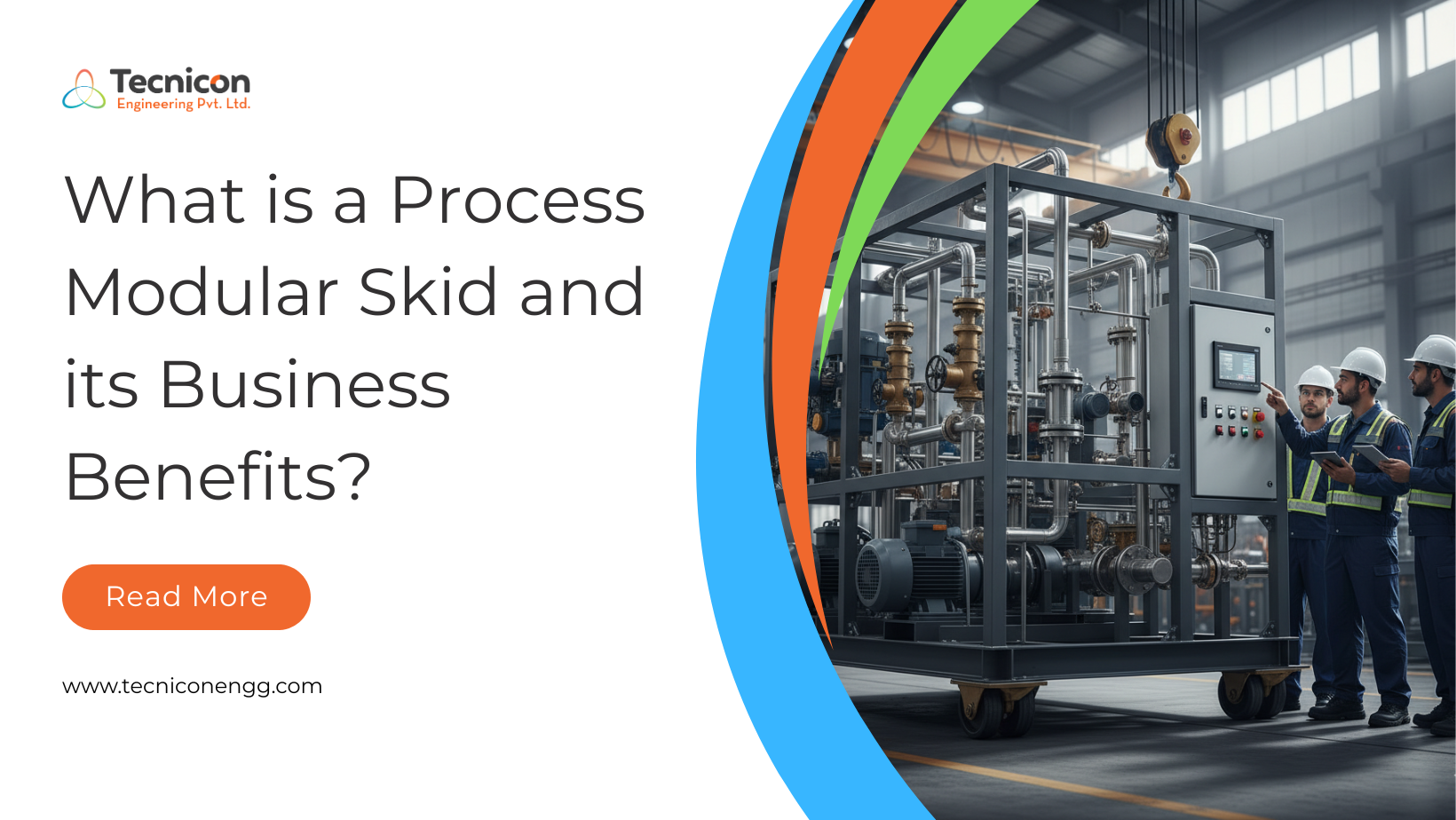
What is a Process Modular Skid and its Business Benefits?
In industrial manufacturing and process engineering, time, cost, and reliability are everything. Project delays cost money. Installation errors cause downtime. Oversized equipment wastes floor space. These are challenges that plant managers, project engineers, and procurement teams deal with on every new project.
A process modular skid is one of the most practical and proven solutions to all three of these problems. It has transformed the way industries in India and globally design, build, and deploy complex process systems from chemical plants and oil refineries to pharmaceutical facilities and water treatment plants.
This guide explains what a process modular skid is, how modular skid systems work, and most importantly, why more and more industrial businesses are choosing them over conventional stick-built installations.
What is a Process Modular Skid?
A process modular skid is a self-contained, pre-engineered unit that integrates all the equipment, piping, instrumentation, valves, electrical wiring, and controls required for a specific process function all mounted on a single structural steel base frame called a skid.
Instead of designing and constructing each component of a process system individually on-site, the entire assembly is engineered, fabricated, tested, and commissioned at a controlled manufacturing facility. Once complete, the skid is transported to the plant site and connected to existing utilities and process lines with minimal on-site work.
In simple terms, a modular skid system works like a plug-and-play industrial system. You define your process requirement, the manufacturer engineers and builds the complete solution off-site, and your team connects and starts it up on arrival.
How Modular Skid Systems Work The Basic Concept
The working principle of a skid mounted process system is straightforward. A process requirement such as chemical dosing, heat transfer, filtration, pumping, or reaction is identified. Engineers design a compact, fully integrated assembly that performs this function independently. All components are mounted on a rigid base frame that can be lifted, moved, and installed as a single unit.
The skid includes all interconnecting piping, instrumentation, control panels, safety devices, and electrical connections required for the system to function. On-site, the only connections needed are the main process inlet and outlet lines, utility connections such as power and water, and signal cables to the plant control system.
This approach eliminates the need for extensive field engineering, on-site fabrication, and the coordination of multiple contractors working simultaneously which is where most project delays and cost overruns originate.
Key Components of a Modular Skid System
A well-engineered process modular skid typically includes the following integrated elements working together as a single process unit.
The structural base frame is the foundation of the entire assembly. It is fabricated from structural steel typically carbon steel, stainless steel, or duplex stainless steel depending on the operating environment and is designed to support the full weight of all mounted equipment under static and dynamic load conditions.
The process equipment mounted on the skid can include pumps, compressors, heat exchangers, reactors, vessels, filters, mixers, or any other equipment required to carry out the intended process function.
The skid mounted piping system interconnects all equipment using prefabricated pipe spools engineered to ASME, ANSI, or other applicable standards. All welds are completed and inspected at the fabrication facility under controlled quality conditions.
Instrumentation and controls are fully integrated, including flow meters, pressure transmitters, temperature sensors, level gauges, and control valves, all wired to a local control panel or PLC system. Automated process skid systems include advanced PLC and SCADA integration for remote monitoring and control.
All safety devices including pressure relief valves, rupture discs, emergency shutdown systems, and alarms are installed and tested before the skid leaves the manufacturing facility.
Business Benefits of Modular Skid Systems Why Industries Are Making the Switch
This is where the real value of a process modular skid becomes clear. The business case is strong, measurable, and applies across virtually every industrial sector.
Significantly Reduced Installation Time on Industrial Projects
One of the most immediate and visible benefits of modular skid systems is the dramatic reduction in on-site installation time. In a conventional project, multiple contractors must coordinate on-site to install equipment, run piping, install instruments, wire electrical systems, and commission each component separately. This sequential process takes months and is highly vulnerable to delays caused by weather, labor shortages, design changes, and coordination failures.
With a pre-engineered skid system, up to 80 percent of all engineering and fabrication work is completed off-site in parallel with site preparation activities. When the skid arrives on-site, installation is reduced to mechanical connections, utility hook-ups, and final commissioning checks. Projects that would typically take four to six months on-site can be completed in two to four weeks. This translates directly into faster project execution, earlier production startup, and earlier return on capital investment.
Lower Capital Cost and Improved Modular Skid ROI
Pre-engineered skid systems consistently deliver lower total project costs compared to conventional field-built installations. The reasons are multiple and compounding.
Fabrication in a controlled workshop environment is significantly more efficient than on-site construction. Labor productivity is higher, material waste is lower, rework is minimized, and quality control is far easier to manage. Bulk purchasing of materials and standardized fabrication processes further reduce unit costs.
Project management costs drop substantially because the number of vendors, contractors, and coordination interfaces is drastically reduced. A single modular skid manufacturer takes responsibility for engineering, fabrication, testing, and delivery replacing what would otherwise require coordination between a structural contractor, a piping contractor, an electrical contractor, an instrumentation contractor, and an automation contractor.
Site civil and structural requirements are also reduced because the skid arrives as a complete assembly requiring only a prepared foundation rather than a full field construction area.
Industries that have shifted to cost-effective process systems using modular skids consistently report total installed cost reductions of 20 to 35 percent compared to equivalent stick-built installations.
Reduced Downtime and Improved Plant Reliability
Every industrial plant manager understands the cost of unplanned downtime. When a process system is built entirely on-site using multiple contractors, quality variability is high, testing is difficult to conduct comprehensively before startup, and commissioning problems frequently surface after the system is already integrated into the plant.
A process modular skid is fully shop-tested before it ever reaches your site. Pressure testing, leak testing, functional testing of all instruments and controls, and performance testing under simulated operating conditions are all completed at the fabrication facility. By the time the skid is installed and connected, it has already been proven to work.
This rigorous pre-delivery testing dramatically reduces commissioning time and startup risk, reduces downtime industrial plants experience during initial operation, and gives plant operators greater confidence from day one.
Scalability and Flexibility for Expanding Operations
One of the most strategically valuable features of a modular skid system is its inherent scalability. Because each skid functions as an independent process unit, capacity can be expanded by adding additional skids without shutting down existing operations or undertaking a major plant expansion project.
This plug and play industrial system approach means that a business can start with the capacity it needs today, validate the process, and scale up incrementally as demand grows without the massive upfront capital commitment that a traditional plant expansion would require. This flexibility is particularly valuable for growing businesses in sectors such as specialty chemicals, pharmaceuticals, and food processing where market demand can be difficult to predict precisely.
Superior Quality Control Through Off-Site Fabrication
When fabrication is carried out in a controlled manufacturing environment, quality is easier to achieve and verify consistently. Workshop fabrication allows for precise dimensional control, proper weld inspection using NDT methods, accurate instrument calibration, and thorough documentation of every component and connection.
This level of quality assurance is extremely difficult to achieve consistently in field construction, where working conditions, access constraints, and environmental factors all introduce variability. The result is a modular skid system that typically delivers higher mechanical integrity and longer operational life compared to field-fabricated equivalents.
Space-Efficient and Compact Process Systems
Industrial floor space is valuable. Modular skid design prioritizes compact packaging all equipment is arranged in three dimensions using elevated platforms, overhead pipe routing, and optimized equipment spacing. The result is a compact process system that occupies a fraction of the footprint that a conventional spread-out field installation would require.
For brownfield projects where space is limited, or for facilities that need to add new process capacity without expanding the building envelope, this compactness is a critical advantage.
Industry-Specific Applications of Process Modular Skids
Process modular skids are used across a wide range of industries in India and internationally. Each sector benefits from the core advantages of faster deployment, lower cost, and higher quality, with specific design variations to meet industry requirements.
Modular Skid for Chemical Industry
Chemical processing involves high temperatures, corrosive fluids, and stringent safety requirements. Modular skids for the chemical industry are engineered with appropriate materials of construction typically stainless steel or high-alloy materials and are designed to meet ATEX or hazardous area classification requirements where necessary. Common applications include chemical dosing systems, solvent recovery units, reactor feed systems, and heat transfer skids.
Oil and Gas Skid Systems
The oil and gas sector is one of the largest users of skid mounted equipment globally. Oil and gas skid systems are used for wellhead control, gas compression, metering, chemical injection, produced water treatment, and separation. These skids must withstand harsh outdoor environments, high pressures, and stringent international safety standards such as ASME, API, and NACE.
Pharmaceutical Skid Systems
Pharmaceutical manufacturing demands the highest levels of cleanliness, material traceability, and documentation. Pharmaceutical skid systems are fabricated in sanitary stainless steel with electropolished internal surfaces, full material traceability certificates, and comprehensive documentation packages compliant with FDA, GMP, and GAMP guidelines. Common applications include purified water systems, Clean-in-Place systems, formulation mixing skids, and buffer preparation units.
Water Treatment Skid Systems
Water treatment skid systems are used for municipal water treatment, industrial effluent treatment, reverse osmosis, ultrafiltration, and demineralization. These compact, pre-engineered skids can be deployed quickly at remote or distributed locations and are easily expanded as treatment capacity requirements grow.
Food Processing Skid Solutions
Food processing requires hygienic design, ease of cleaning, and compliance with food safety regulations. Food processing skid solutions use sanitary fittings, sloped surfaces for drainage, and materials approved for food contact. Applications include pasteurization systems, CIP skids, batching and blending systems, and cooling and heating circuits.
API Skid Systems Manufacturing
Active Pharmaceutical Ingredient manufacturing involves complex multi-step reactions under precise temperature and pressure conditions. API skid systems are engineered for high precision, full containment, and complete process control integration, reducing the risk of cross-contamination and ensuring product quality consistency.
What Makes a Good Process Modular Skid Manufacturer in India?
Choosing the right modular skid manufacturer in India is as important as the decision to use modular skids in the first place. The quality of engineering, fabrication, and testing varies significantly between suppliers, and the consequences of a poorly executed skid can offset all the benefits described above.
A capable industrial skid system supplier should have in-house engineering capability covering process design, mechanical engineering, piping design, instrumentation, and electrical engineering. They should be able to work from your process requirements and develop a complete design without relying on external sub-contractors for core engineering activities.
Fabrication capability should include certified welding to ASME or equivalent standards, in-house pressure testing facilities, NDT inspection capability, and a documented quality management system ideally ISO 9001 certified.
Project management discipline is equally important. A turnkey skid mounted system provider who delivers on schedule, communicates proactively, and maintains documentation to a professional standard is worth significantly more than a lower-cost supplier who delivers late with incomplete paperwork.
Finally, look for a manufacturer who offers post-delivery support including commissioning assistance, operator training, and spare parts supply. A process modular skid will operate for 15 to 25 years the relationship with your manufacturer should be designed to last accordingly.
Conclusion
A process modular skid is far more than a structural steel frame with equipment bolted to it. It is a complete, pre-engineered, pre-tested process solution that delivers measurable business value at every stage from project planning and capital approval through to installation, startup, and long-term operation.
For industrial businesses in India looking to reduce project timelines, control capital costs, improve plant reliability, and scale operations efficiently, modular skid systems represent one of the most strategically sound investments available today. The technology is proven, the suppliers are increasingly capable, and the business case is clear.
Whether you are planning a new greenfield facility, expanding an existing plant, or replacing ageing process equipment, a custom process skid solution deserves serious evaluation before any other approach is committed to.