
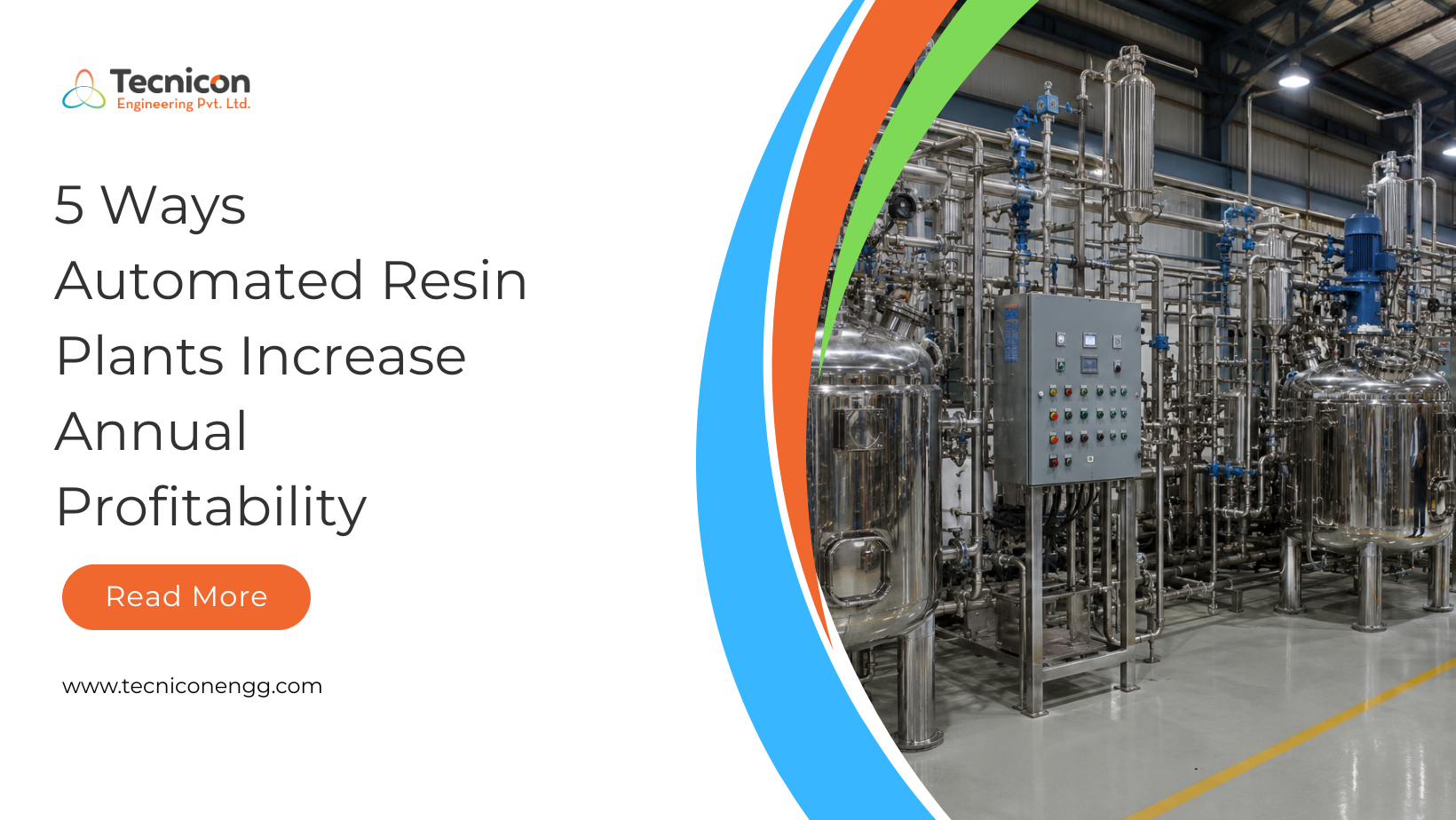
5 Ways Automated Resin Plants Increase Annual Profitability
Labour costs are rising. Raw material prices are volatile. Customers expect tighter quality tolerances than ever before. And yet, many resin manufacturers across India are still running semi-manual or legacy processes that were designed for a different era.
Automated resin plants profitability is no longer a theoretical concept it is a measurable, documented reality for manufacturers who have made the shift. Plants that automate their resin production consistently report lower waste, higher output, and stronger margins year after year.
Why Automated Resin Plants Are Transforming the Industry
The Shift from Manual to Automated Resin Production
Traditional resin manufacturing relies heavily on operator judgement, manual sampling, and process corrections based on experience rather than real-time data. This creates variability in batch quality, cycle time, raw material usage, and energy consumption.
Automated resin production efficiency eliminates this variability at the source. By deploying PLC-based control systems, SCADA platforms, and integrated sensors, manufacturers gain precise, repeatable control over every stage of the reaction process from raw material dosing to final product discharge.
Why India’s Resin Industry Is Ready for This Transition
India’s resin and allied chemical manufacturing sector is growing rapidly, with Gujarat remaining the hub of resin plant manufacturer India activity. As global buyers demand higher quality and greater supply consistency, Indian manufacturers are under pressure to modernise.
The good news: the resin plant cost India for automation has dropped significantly over the last decade. PLC and SCADA systems that once required enormous capital investment are now accessible to mid-scale producers making the resin plant upgrade India decision more financially viable than ever.
5 Ways Automated Resin Plants Increase Annual Profitability
Way 1 Dramatic Reduction in Raw Material Waste
How Manual Processes Waste Raw Materials
In a manually operated resin plant, raw materials resins, acids, alcohols, solvents, and catalysts are dosed by operators using manual valves, flow meters, and visual cues. Even experienced operators introduce batch-to-batch variation of 2–5% in raw material quantities.
Over hundreds of batches per year, this adds up to enormous waste. A 3% overuse of key raw materials in a plant producing 5,000 MT per year can translate to lakhs of rupees in avoidable raw material costs annually.
How Automation Solves It
Automated resin plants use load cells, mass flow meters, and automated valves to dose raw materials with accuracy to within 0.1–0.5%. The PLC executes the recipe exactly every time, without deviation.
The result: Raw material consumption aligns tightly with theoretical recipe yields, dramatically cutting waste and directly improving gross margins. This is one of the most immediate cost savings from automation in resin production that manufacturers experience.
Practical tip: Pair your automation upgrade with a recipe management system (RMS) to lock in proven formulations and prevent unauthorised deviations.
Way 2 Higher Throughput Without Additional Headcount
The Bottleneck in Semi-Manual Plants
In a semi-manual resin plant, throughput is fundamentally limited by the number of operators on shift, their availability, and the time required for manual tasks sampling, adjustments, transfers, and approvals. Idle reactor time between steps is common and costly.
How Automation Increases Throughput
With industrial automation for resin plants India, the control system manages step transitions automatically. When a reaction reaches a target acid value, the system advances to the next stage no waiting for an operator to test, record, and decide. Heating, cooling, vacuum application, and material transfers all happen on schedule.
This typically reduces batch cycle times by 15–25%, allowing the same reactor capacity to produce significantly more output per year.
For example: A reactor running 4 batches per week at 12-hour cycles can, with automation, run 5 batches per week at 9–10-hour cycles. That’s a 25% increase in annual output from the same asset a direct multiplier on revenue.
The role of PLC and SCADA in resin plant automation is central here: the PLC executes sequences precisely, while SCADA gives operators full visibility to supervise multiple reactors simultaneously, further reducing headcount requirements.
Way 3 Consistent Product Quality That Reduces Rejections and Rework
Quality Variability Is a Hidden Profit Drain
Off-spec batches are expensive. They require rework (additional energy, time, and materials), and in the worst case, they result in disposal a total loss. Even batches that are technically within specification but at the edge of tolerances create downstream problems for customers.
In resin manufacturing company India contexts, off-spec product can damage customer relationships, trigger penalty clauses, and increase the cost of quality testing and inspection.
How Automation Delivers Consistent Quality
Automated systems monitor reaction parameters temperature, viscosity, acid value, hydroxyl value in real time and make micro-corrections continuously. The result is a process that holds within tight tolerances throughout every batch.
Benefits of automation in resin manufacturing industry from a quality standpoint include:
- Fewer off-spec batches (typically a 60–80% reduction reported by automated plants)
- Faster batch approval due to consistent parameter profiles
- Lower QC testing costs as batch predictability increases
- Stronger customer satisfaction and repeat business
Consistent quality is not just a technical achievement it is a commercial differentiator that supports premium pricing and long-term contracts.
Way 4 Significant Energy Cost Reduction
Where Energy Is Wasted in Manual Resin Plants
Energy is one of the largest operating costs in resin production. Heating and cooling cycles, vacuum systems, and agitators consume significant power and fuel (thermic fluid heaters, steam). In manual plants, energy is routinely wasted through:
- Extended batch hold times while waiting for operator intervention
- Inconsistent temperature control leading to overcooling and reheating cycles
- Idle equipment left running between process steps
How Automation Optimises Energy Usage
Process automation solutions India-based manufacturers are implementing allow for precise temperature profiling heating at the optimal rate, holding exactly at target, and transitioning to cooling at precisely the right moment. This eliminates energy-wasting overshoot and undershoot cycles.
Additionally, automated load management ensures auxiliary equipment (agitators, pumps, vacuum systems) runs only when the process requires it not continuously as a default.
Plants that implement chemical plant automation India typically report energy savings of 10–20% per batch. At scale, this represents a substantial annual saving on fuel and electricity costs improving EBITDA margins directly.
Smart manufacturing resin industry India leaders are also integrating energy monitoring dashboards into their SCADA systems, giving plant managers real-time visibility into energy performance and enabling continuous improvement.
Way 5 Lower Labour Costs and Reduced Human Error Risk
The True Cost of Manual Operations
Labour costs in chemical manufacturing extend well beyond salaries. Consider the full picture:
- Overtime and shift premiums for 24/7 operations
- Training costs for new operators
- Errors caused by fatigue, distraction, or miscommunication
- Near-miss incidents and safety events related to manual chemical handling
- Management time spent on troubleshooting and batch investigation
How to improve efficiency in resin production plants through automation directly addresses all of these costs simultaneously.
What Automation Changes
With industrial control systems India-compliant automation platforms, one trained operator can supervise multiple reactors from a central control room. Manual tasks valve operation, temperature logging, sampling at every stage are dramatically reduced or eliminated.
Human intervention is reserved for high-value judgement calls: approving new recipes, managing non-standard situations, and overseeing maintenance activities. This is where skilled employees add the most value.
Key outcomes include:
- Reduced operator headcount per shift (or redeployment to higher-value roles)
- Elimination of transcription errors in batch records (automated data logging)
- Digital audit trails that simplify regulatory compliance and customer audits
- Improved workplace safety as operator exposure to hot reactors and chemical handling is minimised
For turnkey resin plant India projects, modern automation packages are now included as standard meaning new plants are built automation-ready from day one rather than retrofitted later.
Key Features to Look for in an Automated Resin Plant
Not all automation systems deliver equal results. When evaluating automated resin plant supplier Gujarat or India-based options, look for these critical capabilities:
- PLC-based recipe management with password-protected access levels and full audit trail
- SCADA integration with real-time dashboards, trend logging, and alarm management
- Inline quality sensors (viscosity, temperature, acid value) to reduce manual sampling
- Automatic raw material dosing via load cells and mass flow meters
- Batch reporting with automatic generation of batch records for QC and compliance
- Remote monitoring capability for supervision by management from any location
- Scalable architecture that allows additional reactors and processes to be integrated over time
These features collectively define a mature automation systems for chemical industry India platform one that will deliver measurable ROI rather than just operational novelty.
Common Mistakes When Upgrading to an Automated Resin Plant
Understanding how to upgrade to an automated resin plant correctly requires avoiding these common pitfalls:
Mistake 1: Automating a poorly optimised process Automation amplifies whatever process you have. If your recipes or reactor configurations have inefficiencies, automate only after process optimisation not before.
Mistake 2: Under-investing in operator training Automation changes the operator’s role, not eliminates it. Invest in PLC/SCADA training to ensure your team can operate, troubleshoot, and maintain the system effectively.
Mistake 3: Choosing a vendor without resin-specific experience Resin chemistry is specific. General industrial automation vendors may not understand the nuances of polyester, alkyd, epoxy, or phenolic resin processes. Work with a resin plant manufacturer India that has proven domain expertise.
Mistake 4: Ignoring cybersecurity for SCADA systems As plants connect SCADA to enterprise networks and cloud platforms, cybersecurity becomes critical. Ensure your industrial control systems India supplier follows established cybersecurity protocols for OT environments.
The Future of Automated Resin Plants in India
The future of automated resin plants in India is being shaped by several converging trends:
AI-assisted process optimisation Machine learning algorithms that analyse historical batch data to recommend recipe improvements and predict quality outcomes before a batch completes.
Cloud-based SCADA and remote monitoring Plant managers overseeing multiple facilities from a single dashboard, with mobile alerts for critical process deviations.
Digital twin technology Virtual replicas of reactor systems used to test new recipes or process changes without risking production batches.
Energy and sustainability integration Automation platforms that track carbon footprint and energy intensity per batch, supporting ESG reporting requirements.
Indian resin manufacturers who invest in smart manufacturing resin industry India infrastructure today will be positioned to compete globally not just domestically as these capabilities become standard expectations for international buyers.
Conclusion:
The evidence is consistent and compelling. Automated resin plants profitability is not a marketing claim it is a financial reality for manufacturers who make the transition thoughtfully.
To recap the five ways automation drives annual profitability:
- Reduced raw material waste through precise automated dosing
- Higher throughput from faster, automated batch cycle transitions
- Consistent product quality that eliminates costly rejections and rework
- Lower energy costs through optimised heating, cooling, and equipment usage
- Reduced labour costs and human error through centralised automated control
Each of these benefits compounds annually meaning the longer your automated plant runs, the greater the cumulative financial advantage over competitors still running manual processes.
The resin plant cost India for automation has never been more accessible. The technology is proven, the suppliers are experienced, and the ROI is well-documented. The only question is how long you can afford to wait.
Take the Next Step Toward a More Profitable Resin Plant
If you’re ready to explore what automation can do for your resin manufacturing operation whether you’re building a new plant or upgrading an existing one speak with experts who have delivered results for manufacturers across India.From PLC-SCADA integration to complete greenfield resin plants, their team combines deep chemical process knowledge with proven automation engineering.