
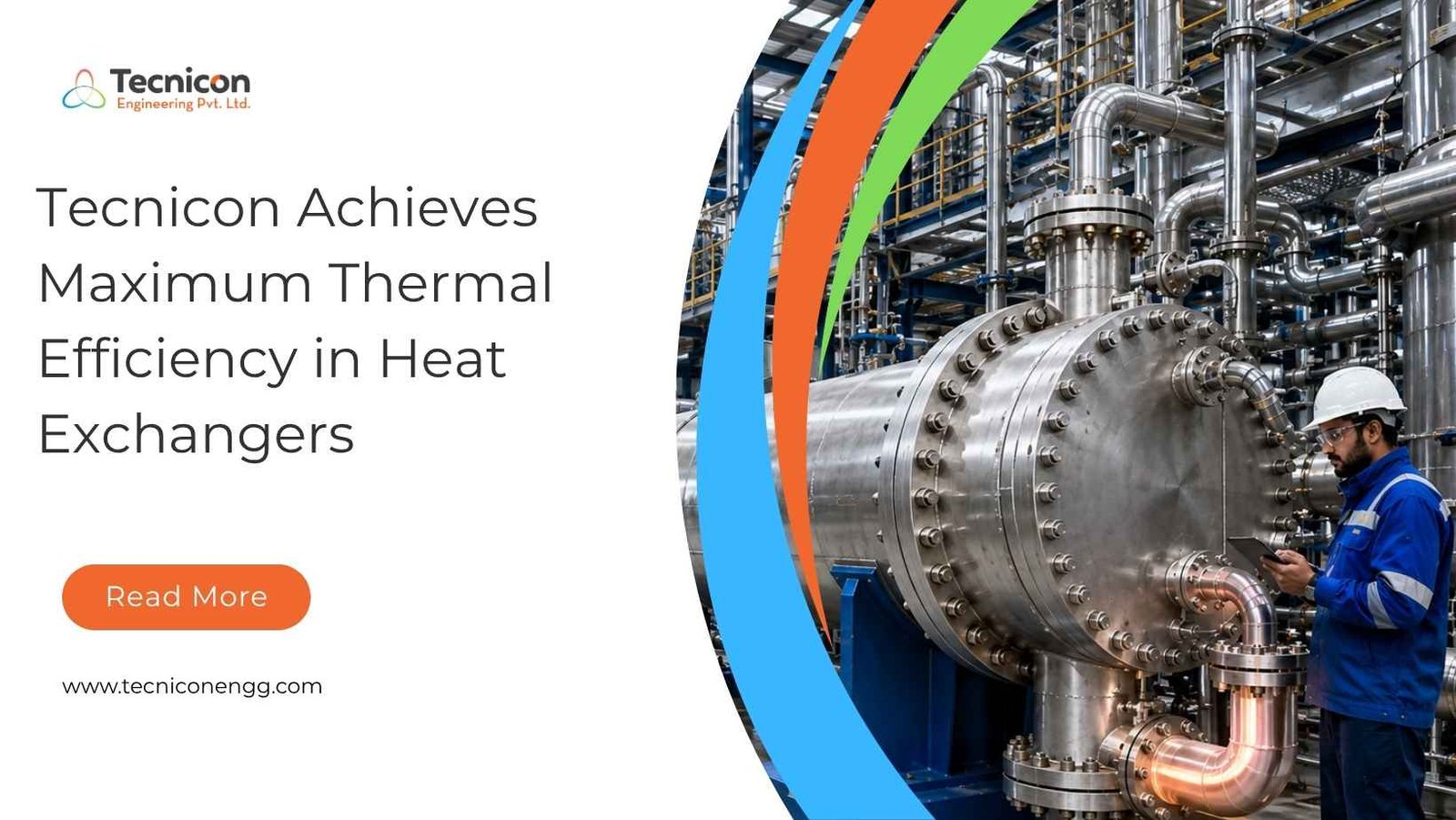
How Tecnicon Achieves Maximum Thermal Efficiency in Heat Exchangers
In industrial processing plants, every degree of heat lost and every kilojoule of energy wasted has a cost measured in fuel bills, reduced output, or missed process targets. For plant engineers and procurement managers across India’s chemical, pharmaceutical, petrochemical, and food processing sectors, the performance of a heat exchanger is not a secondary specification. It is the heartbeat of the process.
As a leading heat exchanger manufacturer in Ahmedabad, Tecnicon Engineering Private Limited has built its reputation on delivering shell and tube heat exchangers that don’t merely meet minimum specifications they are engineered from the ground up to achieve maximum thermal efficiency under real industrial operating conditions. This article explains exactly how Tecnicon does it.
What Does Thermal Efficiency Really Mean in Industrial Heat Exchangers?
Before examining Tecnicon’s approach, it is worth defining what thermal efficiency means in practical terms. In the context of industrial heat transfer equipment, thermal efficiency refers to how effectively a heat exchanger transfers heat between two fluids relative to the maximum theoretically possible heat transfer under the same conditions.
A poorly designed heat exchanger wastes energy, creates excessive pressure drops, fouls rapidly, and forces processes to consume more utilities steam, cooling water, or refrigerants than necessary. In large-scale chemical or pharmaceutical plants, this inefficiency translates directly into higher operating costs, increased carbon output, and suboptimal product quality. The benefits of high-efficiency industrial heat exchangers are therefore both financial and environmental.
Tecnicon’s Design-First Engineering Philosophy
Precision Thermal Design Before a Single Weld Is Made
Thermal efficiency begins at the design stage not on the shop floor. Tecnicon follows a design-first approach for all its process heat exchangers, ensuring that key thermal parameters are fully calculated before fabrication begins. These include:
- Heat Transfer Area: Sized precisely based on the process duty requirement (expressed in m²)
- Overall Heat Transfer Coefficient (U): Calculated for the specific fluid pair, with values ranging from approximately 200–1,000 W/m²·K for liquid-liquid applications and up to 1,500–3,000 W/m²·K for steam-water service
- Pressure Drop Optimization: Both tube-side and shell-side pressure drops are kept below 0.5 bar (typical) to minimize pumping energy consumption
- Temperature Range: Tecnicon’s heat exchangers are designed for inlet temperatures from 60°C to 150°C (process fluid) with customizable outlet temperature targets based on cooling or heating medium
The Engineering Architecture Behind Tecnicon’s Shell and Tube Heat Exchangers
The shell and tube heat exchanger is the most widely used configuration in industrial process plants worldwide, and for good reason. Its design allows for a large heat transfer surface area within a compact shell, precise multi-pass arrangements, and flexibility in material selection. Tecnicon manufactures these units across a wide performance envelope:
- Heat Transfer Area: 1 m² to 500 m² (customized as per process requirement)
- Design Pressure: Full vacuum to 100 bar (g), with special designs up to 200 bar
- Design Temperature: –20°C to +400°C
- Number of Tube Passes: Single, two-pass, four-pass, or multi-pass configurations
- Flow Arrangements: Counterflow, parallel flow, or crossflow
Multi-Pass Configuration for Maximum Temperature Driving Force
One of the most effective ways to improve thermal efficiency in a shell and tube heat exchanger is to use counterflow or multi-pass tube arrangements. By having the hot and cold fluids flow in opposite directions across multiple passes, the temperature difference (the driving force for heat transfer) is maintained at a higher average value throughout the exchanger.
Tecnicon’s heat exchangers are available in single-pass through to four-pass and beyond, with the pass configuration selected based on process thermal calculations not by default.
Baffle Design and Spacing Where Many Manufacturers Cut Corners
Baffles are structural components inside the shell that direct shell-side fluid flow across the tube bundle, rather than allowing it to bypass axially. Properly designed baffles dramatically increase the velocity and turbulence of the shell-side fluid, which in turn significantly improves the shell-side heat transfer coefficient.
Research published in peer-reviewed technical literature confirms that shell-side heat transfer efficiency increases as baffle spacing decreases, due to enhanced fluid velocity and turbulence across the tube bundle.
Tecnicon designs baffle spacing based on thermal requirements typically 20% to 100% of shell diameter selecting from segmental, disc-and-doughnut, or helical baffle configurations depending on the service. This attention to baffle geometry is a key factor in how Tecnicon’s high performance heat exchangers in Gujarat consistently deliver superior shell-side heat transfer coefficients.
How Stainless Steel Reduces Energy Loss and Improves Heat Exchanger Durability
The Material Advantage of Stainless Steel in Industrial Heat Exchangers
The choice of tube and shell material is one of the most consequential decisions in heat exchanger design. Tecnicon manufactures stainless steel heat exchangers using SS 304, SS 316, and other alloys selected based on the process fluid chemistry and temperature requirements.
As industry material experts have established, stainless steel offers excellent thermal conductivity combined with outstanding corrosion resistance, high-temperature strength, and a non-porous hygienic surface making it a superior choice for most demanding industrial applications. Critically, how stainless steel heat exchangers reduce energy loss comes down to wall thickness and fouling behavior. Carbon steel tubes require significantly thicker walls to achieve comparable corrosion resistance and thicker walls mean greater thermal resistance, which reduces the effective heat transfer coefficient. Stainless steel tubes, by contrast, can be fabricated with thinner walls that maintain both structural integrity and corrosion protection, maximizing heat transfer through the tube wall.
SS 316 for Corrosive and Pharmaceutical Applications
For applications in pharmaceutical manufacturing, dairy processing, aggressive chemical service, or chloride-bearing environments, Tecnicon specifies SS 316 stainless steel. The SS 316L variant, with its lower carbon content, provides enhanced resistance to sensitization during welding and is particularly suited to GMP (Good Manufacturing Practice) process environments.
Tecnicon manufactures both GMP heat exchangers and Non-GMP heat exchangers specifically for pharmaceutical and food processing plants in Gujarat and across India.
Code Compliance as a Foundation for Long-Term Thermal Performance
TEMA Standards The Global Benchmark for Shell and Tube Heat Exchanger Design
Tecnicon designs and fabricates heat exchangers to TEMA (Tubular Exchanger Manufacturers Association) standards the globally accepted authority on shell and tube heat exchanger mechanical design. As TEMA’s official body states, TEMA standards have “achieved worldwide acceptance as the authority on shell and tube heat exchanger mechanical design.TEMA standards cover design tolerances, fabrication methods, tube pitch, baffle specifications, and gasket selection all of which directly influence thermal performance. Tecnicon follows TEMA B classification for chemical process service and TEMA R for refinery-grade applications, ensuring the appropriate level of rigor for each industrial context.
ASME and API 660 Compliance
In addition to TEMA, Tecnicon fabricates heat exchangers to ASME Section VIII Division 1 and API 660 (heat exchangers for petroleum, petrochemical, and natural gas industries) where applicable. This multi-standard compliance ensures that Tecnicon’s units are accepted for use in regulated industries such as oil and gas, pharmaceuticals, and power generation not just in India but in export markets as well.
Industry Applications Where Tecnicon’s Thermal Efficiency Delivers Real Value
The advantages of shell and tube heat exchangers in manufacturing become most evident when examined sector by sector. Tecnicon’s industrial heat transfer equipment serves:
- Chemical and Specialty Chemicals: Condensers, coolers, and process heaters handling aggressive solvents, acids, and high-temperature streams
- API and Pharmaceuticals: GMP-compliant SS heat exchangers for sterile process streams, API crystallization, and solvent recovery where contamination prevention is non-negotiable
- Petrochemicals: High-pressure units rated to 70 bar and above, fabricated in SS 316 for corrosive hydrocarbon streams
- Food Processing: Hygienic stainless steel units for pasteurization, CIP-compatible designs with smooth internal surfaces
- Power Plants and HVAC: Condensers and coolers for utilities management
For each of these sectors, the best heat exchanger solutions for industrial processing plants are those that combine process-matched thermal design, code-compliant fabrication, and the right material selection the three pillars of Tecnicon’s design philosophy.
Testing and Quality Assurance Protecting Thermal Performance Over the Long Term
A heat exchanger that performs well on day one but degrades rapidly due to leaks, fouling, or weld defects will consume progressively more energy as its effective heat transfer coefficient drops. Tecnicon addresses this through comprehensive testing protocols applied to every unit:
- Hydrostatic Testing pressure integrity across all joints and welds
- Pneumatic Testing leak detection under air pressure
- Radiography Testing (RT) internal weld quality verification
- Dye Penetrant Testing (DPT) surface defect detection
- Ultrasonic Testing (UT) sub-surface discontinuity detection
These tests are not optional add-ons at Tecnicon they are standard practice aligned with ASME Section VIII requirements. The result is a heat exchanger that enters service with verified integrity and maintains its designed thermal performance over its full operational life.
Why Gujarat and Ahmedabad Are the Right Base for a World-Class Heat Exchanger Manufacturer
Tecnicon’s location at Amarnath Industrial Park, Bhavda, Ahmedabad, places it at the centre of India’s most capable process equipment manufacturing ecosystem. Access to quality stainless steel raw materials, specialized fabrication skills, and established logistics for both domestic delivery and export makes Gujarat the natural home for industrial heat exchanger suppliers serving India and international markets.
As a recognized heat exchanger fabrication company in Gujarat, Tecnicon combines this locational advantage with ISO 9001:2015 certified quality systems, ensuring that cost-competitive Indian manufacturing does not mean any compromise on design integrity or thermal performance.
Conclusion: Thermal Efficiency Is an Engineering Achievement, Not a Marketing Claim
Maximum thermal efficiency in a heat exchanger is not achieved through slogans. It is the result of precise thermal design calculations, intelligent baffle and pass configuration, the right material selection for the application, code-compliant fabrication, and rigorous multi-stage quality testing. Tecnicon Engineering integrates all of these elements into every shell and tube heat exchanger it manufactures.
For plant engineers and procurement professionals across India’s chemical, pharmaceutical, food processing, and petrochemical industries whether searching for a heat exchanger manufacturer near you, a specialist SS heat exchanger supplier in Gujarat, or a trusted energy efficient heat exchanger manufacturer in India Tecnicon Engineering offers the rare combination of engineering depth, certified quality, and practical industrial experience.