
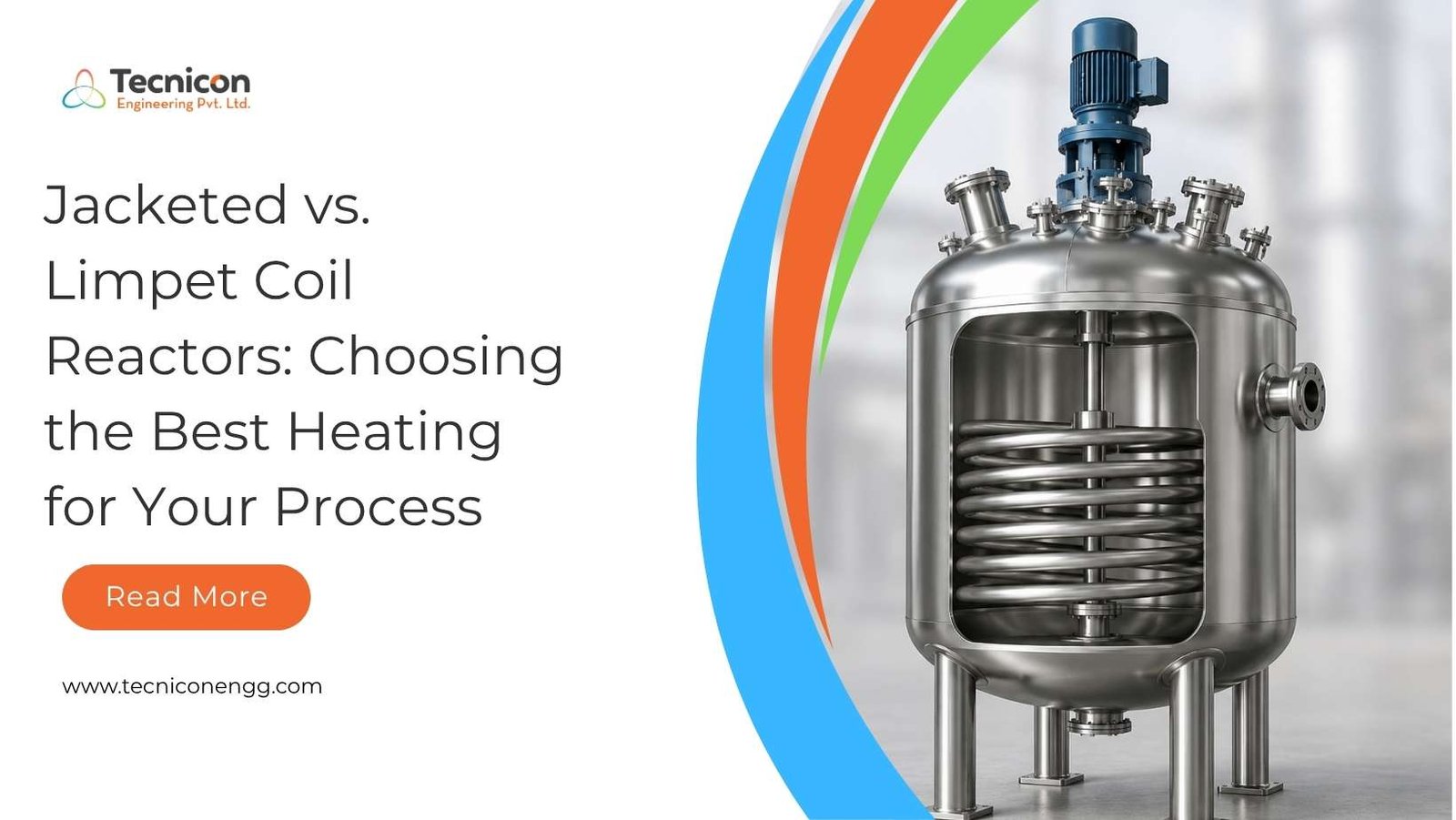
Jacketed vs. Limpet Coil Reactors: Choosing the Best Heating for Your Process
Choosing between a jacketed reactor and a limpet coil reactor comes down to one question: how much heat transfer does your process actually need, and at what pressure? Both designs circulate a heating or cooling medium around a reaction vessel, but they do it in very different ways, and that difference affects everything from capital cost to temperature uniformity. how each system works, where each one performs best, and how to decide which reactor heating system fits your process, whether you’re specifying equipment for a pharma batch reactor or a large-volume chemical process reactor.
What Is a Jacketed Reactor?
A jacketed reactor is a process vessel surrounded by an outer shell, or jacket, that creates a sealed annular space between the inner vessel wall and the outer casing. A heating or cooling fluid, such as steam, hot oil, chilled water, or glycol, flows through this space, transferring thermal energy through the vessel wall to the process material inside.
The jacket is typically welded around the full cylindrical body of the vessel, and sometimes extends to cover the bottom head as well. Because the fluid fills the entire annular cavity, jacketed reactors provide relatively even heat distribution across the vessel surface, provided the flow is managed correctly.
Common Jacket Types
Not all jackets are built the same way. The main variations include:
- Conventional (plain) jacket : A simple outer shell with a single inlet and outlet, suited to low-pressure applications.
- Dimple jacket : Small indentations pressed into the outer plate increase turbulence and structural strength while using less material.
- Half-pipe coil jacket : Half-pipe sections welded in a spiral around the vessel, allowing higher-pressure operation with a smaller fluid volume than a conventional jacket.
- Agitated jacket : Internal baffling within the jacket forces the heating fluid into a controlled flow path, improving temperature uniformity in larger vessels.
What Is a Limpet Coil Reactor?
A limpet coil reactor uses a pipe or tube coil welded directly onto the outer surface of the reaction vessel in a spiral or helical pattern, rather than enclosing the vessel in a full jacket. The heating or cooling medium travels through this coil, and heat transfer occurs at the points of contact between the coil and the vessel wall.
Because the coil is a discrete pipe rather than a continuous annular chamber, limpet coil reactors typically hold less heat transfer fluid and can be engineered to handle higher pressures within the coil itself. The coil can also be arranged in multiple independent zones, which allows different sections of the vessel to be heated or cooled at different rates, or isolated for maintenance without affecting the rest of the system.
Jacketed vs. Limpet Coil Reactors: Key Differences
| Factor | Jacketed Reactor | Limpet Coil Reactor |
| Heat transfer medium path | Full annular space around the vessel | Spiral pipe/coil welded to vessel exterior |
| Typical pressure rating | Lower to moderate | Higher, since the coil itself can be rated independently |
| Heat distribution | Generally even across full jacketed area | Can vary between coil turns unless closely spaced |
| Fluid volume required | Higher | Lower |
| Zoning flexibility | Limited without internal baffles | Multiple independent zones possible |
| Fabrication complexity | Moderate | Higher, due to precision welding of coil to shell |
| Typical vessel size | Small to large | Small to very large, including field-erected vessels |
| Relative capital cost | Generally lower for standard sizes | Generally higher due to welding labor |
Heat Transfer Efficiency
Jacketed reactors distribute heating fluid across a continuous surface, which tends to produce a more uniform temperature profile in small to mid-sized vessels, especially when the jacket includes internal spiral baffles that direct flow. Limpet coil reactors concentrate heat transfer at the coil-to-shell weld points, so achieving comparable uniformity depends on coil pitch (the spacing between coil turns) and how tightly the coil is wound. A closely pitched limpet coil can approach the uniformity of a jacket while still allowing the higher-pressure operation the coil design supports.
Pressure and Temperature Capability
This is where limpet coil reactors generally have an advantage. Because the coil is a smaller-diameter pipe rather than a large annular chamber, it can typically be rated for higher working pressures without requiring the vessel shell itself to carry that pressure load. This makes limpet coil designs a common choice for processes that need high-pressure steam or high-temperature heat transfer oil as the heating medium.
Vessel Size and Structural Considerations
For smaller reactors, a conventional or dimple jacket is usually simpler and more economical to fabricate. As vessel diameter and volume increase, maintaining even heat distribution with a plain jacket becomes harder, which is one reason larger reactors often move toward half-pipe jackets or limpet coils, both of which allow more controlled fluid flow paths across a bigger surface area.
Maintenance and Repair
A jacketed vessel has fewer weld joints exposed to the heat transfer fluid, since the jacket is one continuous chamber. A limpet coil has many more weld points where the coil meets the shell, which means more inspection points but also more flexibility: a damaged section of coil can sometimes be isolated and repaired without affecting the rest of the reactor.
How to Choose Between a Jacketed and a Limpet Coil Reactor
There’s no single “better” option; the right reactor heating system depends on your process conditions. Use these questions to guide the decision:
- What heating/cooling medium and pressure does the process require?
High-pressure steam or thermic fluid applications generally favor limpet coil construction. - How large is the vessel? Smaller reactors often work well with conventional or dimple jackets; very large vessels benefit from the flow control that half-pipe jackets or limpet coils provide.
- Does the process need zoned temperature control?
If different sections of the batch require different heating rates, a multi-zone limpet coil offers more flexibility than a single-pass jacket. - What is the acceptable capital cost?
Limpet coil fabrication generally involves more precision welding, which typically raises manufacturing cost compared to a standard jacket of similar size. - What are the maintenance expectations over the vessel’s service life?
Consider inspection access, cleaning requirements, and how easily the heating system can be repaired without decommissioning the full reactor.
Typical Industry Applications
- Jacketed reactors are widely used in pharmaceutical batch processing, resin manufacturing, and specialty chemical synthesis where moderate pressures and even mixing-side heat transfer are priorities.
- Limpet coil reactors are common in large-volume chemical processing, polymerization, and applications requiring high-pressure steam or thermic fluid systems, where the coil’s pressure rating and zoning options add operational value.
Frequently Asked Questions
Can a reactor use both a jacket and a limpet coil?
Yes. Some vessel designs combine a jacket on part of the vessel with a limpet coil on another section, or use a half-pipe coil style jacket that blends characteristics of both approaches. The right combination depends on the specific heat transfer and pressure requirements of the process.
Which option offers better temperature control, jacketed or limpet coil?
Both can achieve precise temperature control when properly engineered. Jacketed vessels with internal baffling and limpet coils with tight coil pitch both distribute heat transfer fluid effectively; the choice usually comes down to pressure rating and zoning needs rather than control precision alone.
Are limpet coil reactors more expensive than jacketed reactors?
Generally, yes, because welding a spiral coil onto a vessel shell is more labor-intensive than fabricating a conventional or dimple jacket. However, for high-pressure applications, a limpet coil can be more cost-effective overall since it avoids the need to pressure-rate the entire jacket chamber.
What materials are jacketed and limpet coil reactors made from?
Both designs are commonly fabricated in stainless steel (such as SS 304 or SS 316) for corrosion resistance in pharma and chemical applications, as well as in mild steel for less corrosive processes. Material selection depends on the process fluid, required hygiene standards, and operating environment.
Does vessel size limit the choice between jacket types?
Not strictly, but practical fabrication considerations mean smaller vessels typically favor plain or dimple jackets, while larger or high-pressure vessels more often use half-pipe jackets or limpet coils to maintain flow control and structural integrity across a bigger surface.
Conclusion
Jacketed and limpet coil reactors both solve the same core problem, transferring heat into or out of a process vessel, but they do it through different mechanical approaches with different trade-offs. Jacketed reactors offer simpler fabrication and even heat distribution for moderate-pressure applications, while limpet coil reactors provide higher pressure ratings and zoning flexibility for demanding, large-scale, or high-temperature processes. The right choice depends on your specific process parameters: heating medium, pressure, vessel size, and maintenance expectations.
If you’re evaluating reactor heating options for an upcoming project, working with an experienced industrial reactor manufacturer can help match the vessel design to your actual process data rather than a generic specification. Tecnicon Engineering designs and fabricates both jacketed and limpet coil reactors in Ahmedabad, Gujarat, for pharmaceutical, chemical, and specialty processing applications, and can help you evaluate which configuration fits your operating conditions.