
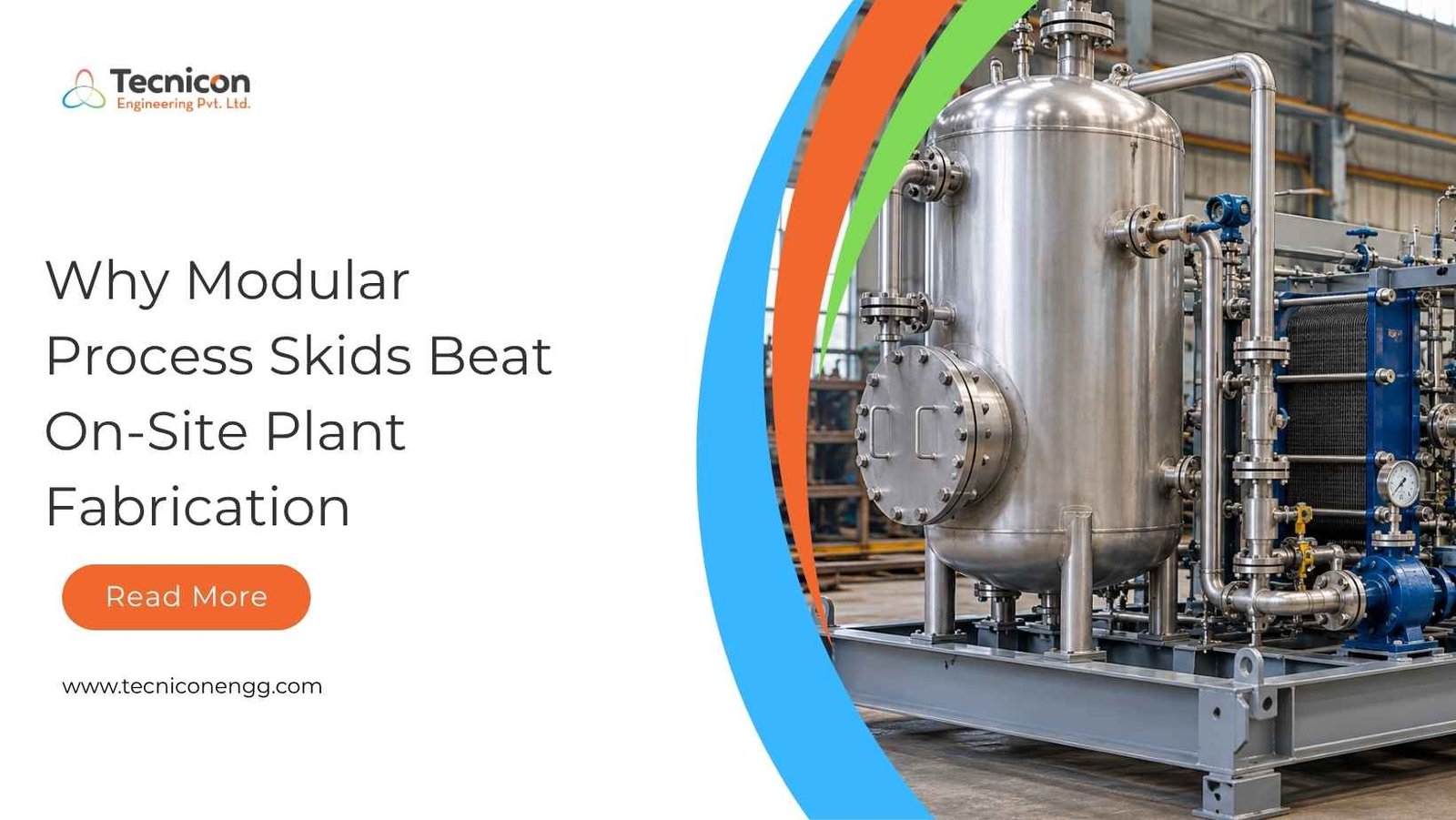
Why Modular Process Skids Beat On-Site Plant Fabrication
Modular process skids beat on-site plant fabrication because they are built, assembled, and tested in a controlled workshop before they reach your plant. Instead of welding pipes, mounting instruments, and wiring panels under site conditions, a process skid manufacturer delivers a pre-engineered unit that needs only utility connections to start operating.
For chemical, pharmaceutical, and specialty industries across India, this changes project timelines, quality control, and risk. Comparing modular process skid systems with on-site plant fabrication helps plant owners and project managers make a sound capital decision.
What Are Modular Process Skids?
Modular process skids are self-contained units in which pumps, vessels, piping, valves, instruments, and control systems are mounted on a single structural steel frame. Each skid performs a defined function, such as mixing, heating, filtration, dosing, or transfer.
Because every component sits on one base frame, skid mounted process equipment can be lifted, transported, and placed as a complete unit. Several skids can be linked to form a larger modular process plant. Many buyers prefer turnkey process skid systems, where one supplier handles design, fabrication, testing, and delivery.
How Modular Process Skids Reduce Installation Time
On-site plant fabrication runs tasks in sequence: civil work, structural erection, piping, instrumentation, and electrical work. A delay in one stage holds up the next.
Modular plant fabrication changes that sequence:
- Skid fabrication proceeds in the workshop while foundation work continues at the site.
- Piping, instruments, and electrical work are completed before shipping.
- On arrival, the skid is positioned, anchored, and connected to utilities.
This parallel approach shortens the schedule and reduces the number of contractors working at your plant. Commissioning is also quicker because the equipment has already been tested.
Quality Control: Workshop vs Site Conditions
Process skid fabrication in a dedicated facility gives engineers control over the environment. Welding, surface finishing, and pressure testing happen under supervision, with proper tools, lighting, and material handling.
On-site fabrication faces dust, heat, rain, limited space, and variable labor skill. These factors can affect weld quality, especially on stainless steel and alloys used in chemical service.
A shop-built industrial process skid can go through documented checks before dispatch:
- Dimensional inspection
- Weld inspection and non-destructive testing, where specified
- Hydrostatic or pneumatic pressure testing
- Instrument calibration and loop checks
- Factory acceptance testing (FAT)
Problems found during FAT are corrected in the workshop, which costs far less than rework inside a running plant.
Cost Advantages of Modular Process Equipment
The cost benefit goes beyond the equipment price. Modular process equipment typically reduces:
- Site labor and supervision costs, since less work happens on location
- Project overruns, because scope and design are fixed earlier
- Idle time, because production can start sooner
- Rework, because testing happens before delivery
On-site fabrication often looks cheaper at the quotation stage, but weather delays, labor shortages, and coordination gaps between contractors can raise the final cost. A pre-engineered skid gives a clearer budget from the start.
Safety and Site Disruption
Fabrication on an operating site brings welding, lifting, and hot work close to existing production. This raises safety risks and may force shutdowns.
Building the skid off-site moves most hazardous activity away from your facility. Fewer contractors means fewer permits, less congestion, and lower exposure to incidents. For brownfield expansions, where new capacity must sit next to running units, this advantage is especially valuable.
Why Choose a Modular Process Skid Manufacturer in India?
Sourcing locally brings practical benefits beyond price. A modular process skid manufacturer in India understands domestic standards, utility conditions, and regulatory expectations, and can support you without long shipping or communication gaps.
Gujarat is one of India’s major industrial states, with a strong base of chemical, pharmaceutical, and engineering industries. A modular process skids manufacturer in Gujarat is therefore close to many of the plants that use this equipment. Choosing a process skid manufacturer in Ahmedabad, for example, can make design reviews, workshop inspections, and factory acceptance testing easier to schedule.
Proximity also helps after delivery. When a custom process skid manufacturer is nearby, site visits, spares, and troubleshooting become simpler. Many chemical plants prefer an industrial process skid manufacturer in Gujarat for this reason, particularly when the project involves repeated visits during fabrication.
Flexibility, Scalability, and Relocation
Modular systems are easier to expand. If demand grows, you can add another skid rather than redesign the entire plant. Standardized interfaces also make it simpler to replicate a proven design across multiple locations.
Skids can be relocated if production needs change, which is rarely practical with equipment welded in place. For pilot projects or phased expansions, this adaptability reduces long-term risk.
When On-Site Fabrication Still Makes Sense
Modular skids are not right for every project. On-site fabrication may be suitable when:
- Vessels or columns are too large to transport by road
- Access routes or lifting limits at the site prevent delivery
- The plant layout is highly unconventional and cannot be divided into skid-sized modules
In such cases, a hybrid approach often works well, with critical process sections built as skids and oversized elements completed on site.
What to Look for in a Process Skid Fabrication Company
Choosing the right partner matters as much as choosing the modular approach. When evaluating a process skid fabrication company in Ahmedabad or elsewhere in India, consider:
- Engineering capability: Can the team handle process design, P&ID development, and 3D layout?
- Material expertise: Experience with stainless steel, carbon steel, and corrosion-resistant alloys
- Testing facilities: In-house capacity for pressure testing and FAT
- Customization: Ability to build skids to your capacity, utility, and space requirements
- Documentation: Drawings, material certificates, and test reports supplied with delivery
- Logistics support: Safe packing and transport planning
Conclusion
Modular process skids offer faster installation, better build quality, safer execution, and more predictable costs than on-site plant fabrication. By moving most of the work into a controlled workshop, they reduce site disruption and make commissioning smoother. They also give plants room to scale or relocate as needs change.
On-site fabrication still has a place for oversized or unusual equipment, but for most industrial applications, skid mounted process equipment is the more efficient route. If you are planning a new line or expansion, speaking with an experienced modular process equipment manufacturer in India or Gujarat about your requirements is a practical first step toward a well-engineered, turnkey solution.