
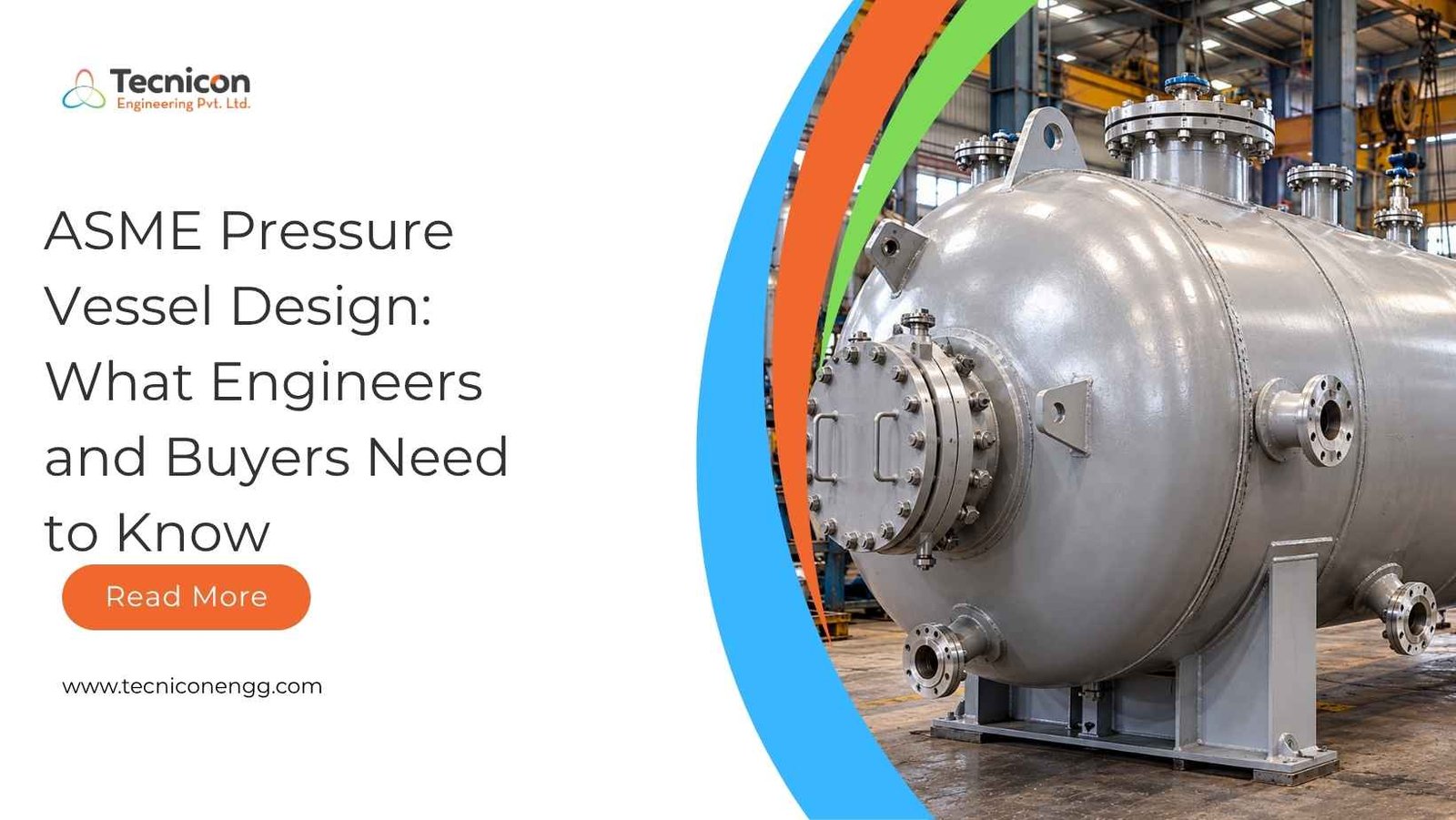
ASME Pressure Vessel Design: What Engineers and Buyers Need to Know
ASME pressure vessel design follows the rules of the ASME Boiler and Pressure Vessel Code (BPVC), most commonly Section VIII, which governs the design, fabrication, inspection, and testing of vessels operating above 15 psig. An ASME pressure vessel is built to a recognized standard and verified by an authorized inspector, which is why it is widely accepted by chemical, pharmaceutical, oil and gas, and power industries worldwide.
This article explains how the code is organized, what goes into design, and what buyers should check before choosing an ASME pressure vessel manufacturer.
What Is an ASME Pressure Vessel?
An ASME pressure vessel is a closed container designed and built to the ASME pressure vessel code to hold gases or liquids at a pressure significantly different from ambient. Common examples include reactors, separators, air receivers, heat exchanger shells, and storage vessels.
The code does not guarantee a good design on its own. It sets minimum requirements for materials, design calculations, welding, examination, and testing. Pressure vessel safety depends on how carefully those requirements are applied, and the code is the baseline for ASME compliance.
Understanding ASME Section VIII
ASME Section VIII has three divisions, each suited to different conditions:
- Division 1: Design by rule. It is the most widely used division for industrial pressure vessels and has been formulated for pressures up to about 3,000 psi (roughly 20 MPa).
- Division 2: Alternative rules, including design by analysis. It allows more detailed stress evaluation and can result in thinner walls for demanding service, but it requires more engineering effort and documentation.
- Division 3: Alternative rules for high pressure vessels, generally above 10,000 psi (about 70 MPa).
Other sections support Section VIII. Section II covers material specifications, Section V covers non-destructive examination, and Section IX covers welding and welder qualification.
Key Inputs in Pressure Vessel Design
Pressure vessel engineering begins with a clear set of design conditions. Typical inputs include:
- Design pressure and operating pressure: Design pressure is set above operating pressure to provide a margin.
- Design temperature and operating temperature: Allowable stress decreases as temperature rises.
- Material specification: Chosen for strength, chemical compatibility, and toughness at low temperature where relevant.
- Corrosion allowance: Additional thickness to compensate for expected material loss.
- Loadings: Wind, seismic, nozzle loads, weight, and external pressure or vacuum.
For a cylindrical shell under internal pressure, Division 1 uses t = PR / (SE − 0.6P), with P as design pressure, R as inside radius, S as allowable stress, and E as weld joint efficiency. Head thickness is calculated with separate formulas depending on whether the head is ellipsoidal, torispherical, or hemispherical. Final design verification should always be done by a qualified engineer against the code edition specified for the project.
Material Selection
Material choice affects safety, service life, and cost. Carbon steel suits many non-corrosive services, while stainless steel grades such as 304 and 316 are common for chemical and hygienic duties. Highly corrosive or high-temperature services may need special alloys.
Every material must be supported by a material test certificate. Allowable stress values come from the code tables for the specific material and temperature, so they should never be assumed from general tables.
Fabrication, Inspection, and Testing
Good pressure vessel fabrication turns a calculated design into a reliable vessel. The main stages include:
- Material verification: Checking heat numbers and certificates against specifications
- Forming and fit-up: Rolling shells, forming heads, and aligning joints
- Welding: Using qualified procedures and welders under Section IX
- Non-destructive examination: Radiography, ultrasonic, dye penetrant, or magnetic particle testing, depending on joint category and design
- Pressure testing: Usually a hydrostatic test at a code-defined multiple of the design pressure
- Final inspection and documentation: Review by an authorized inspector and preparation of the manufacturer’s data report
The extent of radiographic examination affects joint efficiency. Higher examination levels permit higher efficiency values, which can reduce required thickness, though they add inspection cost.
ASME Certification and the U Stamp
A manufacturer authorized to build vessels under Section VIII Division 1 holds an ASME Certificate of Authorization and may apply the U stamp to compliant vessels. This authorization follows a review of the manufacturer’s quality system and is verified by ASME and an authorized inspection agency.
Buyers should ask for the certificate, check that it is current, and confirm that it covers the scope of work. Each finished vessel should come with a data report, material certificates, test records, and a nameplate showing key design details.
Choosing an ASME Pressure Vessel Manufacturer in India
India has a large base of pressure vessel fabricators, but capability varies. When evaluating an ASME pressure vessel manufacturer in India, check for:
- Valid ASME certification for the relevant scope
- In-house design and engineering for pressure vessel calculation and drawings
- Experience with your material and service, such as chemical, high pressure, or hygienic applications
- Qualified welding procedures and NDE capability
- Third-party inspection support
- Complete documentation at dispatch
Gujarat is one of India’s main chemical, petrochemical, and engineering regions, so an ASME pressure vessel manufacturer in Gujarat is often close to the plants that need this equipment. Working with a pressure vessel manufacturer in Ahmedabad can make design reviews, workshop visits, and inspection scheduling easier. Whether you need a custom pressure vessel manufacturer in India or an industrial pressure vessel supplier in Gujarat, review past projects of similar size and duty before finalizing.
Common Buyer Mistakes
- Specifying a code without defining the edition or addendum
- Providing incomplete design conditions, such as missing vacuum or upset cases
- Choosing a supplier on price without checking certification and inspection practices
- Under-specifying corrosion allowance for aggressive service
- Overlooking documentation and inspection requirements until late in the project
A detailed process data sheet and a clear specification help avoid delays and rework.
Conclusion
ASME pressure vessel design combines code-based calculation, correct material selection, controlled fabrication, and independent inspection. Understanding the structure of Section VIII, the main design inputs, and the role of certification helps both engineers and buyers specify and evaluate pressure vessels with confidence.
When you are ready to move forward, share complete design conditions and applicable standards with an experienced pressure vessel engineering company in India. A clear specification at the start leads to safer equipment, fewer revisions, and smoother delivery.