
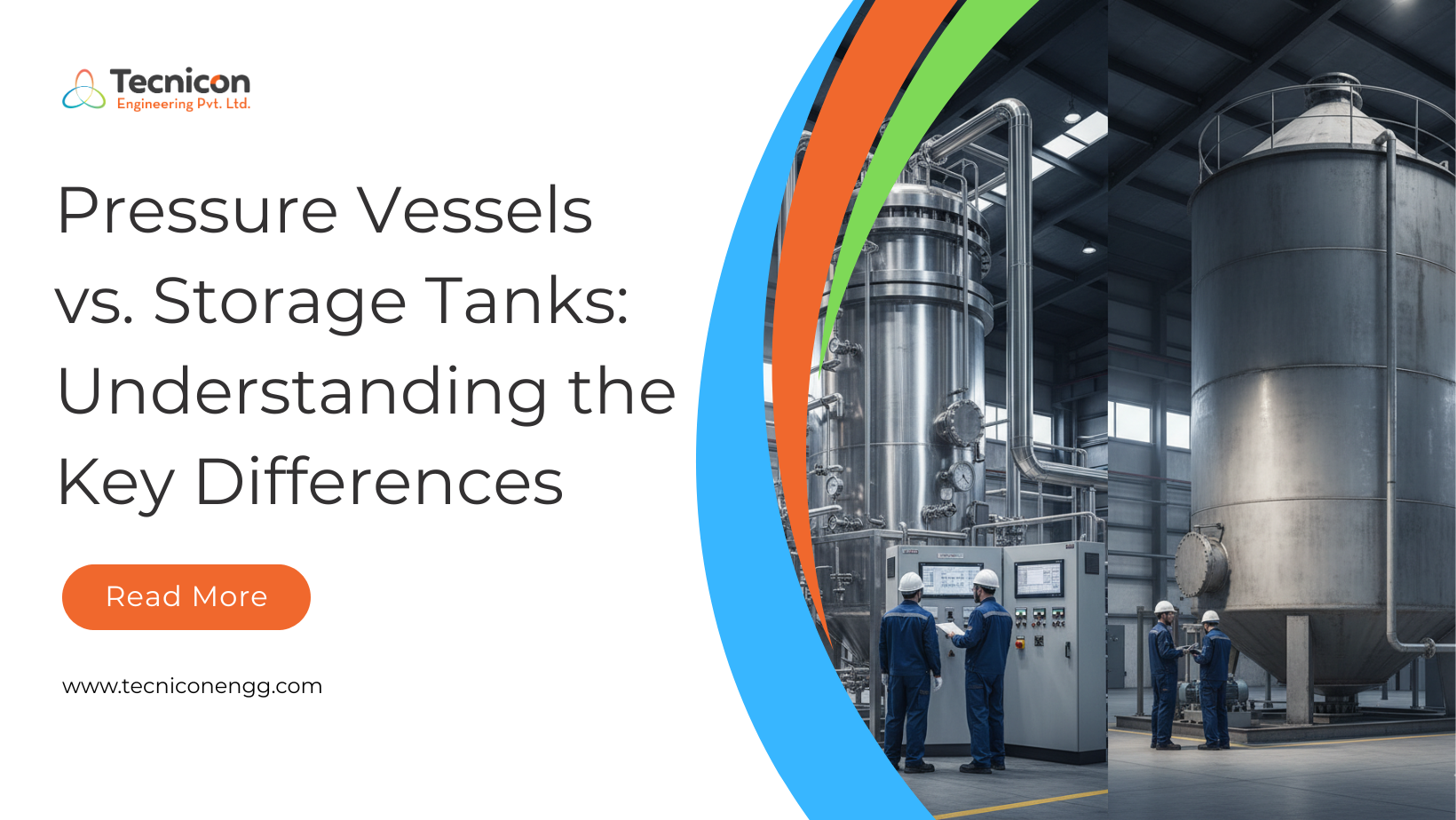
Pressure Vessels vs. Storage Tanks: Understanding the Key Differences
In industrial process engineering, choosing the right equipment for storing or handling fluids and gases is one of the most critical decisions a plant engineer or procurement manager will make. Two of the most commonly used pieces of process equipment are pressure vessels and storage tanks and while they may look similar from the outside, they are fundamentally different in design, engineering, application, and regulatory requirements.
Confusing the two, or using one where the other is required, can lead to serious safety hazards, regulatory non-compliance, equipment failure, and significant financial loss. Understanding the difference between a pressure vessel and a storage tank is not just a technical matter it is a safety and business imperative.
This guide provides a clear, practical comparison of pressure vessels vs storage tanks, covering what each one is, how they differ in design and operation, which industries use them, and how to determine which type of equipment your process actually requires.
What is a Pressure Vessel?
A pressure vessel is a closed container designed to hold gases or liquids at a pressure substantially different from the ambient atmospheric pressure. The defining characteristic of a pressure vessel is that it is engineered to contain internal pressure or in some cases external pressure that exceeds 15 PSI (approximately 1 bar) above atmospheric pressure.
Pressure vessels are used whenever a process requires storing, processing, or transporting fluids or gases under conditions that generate or require elevated pressure. This includes steam generation, chemical reactions, gas storage, heat exchange, and separation processes.
Pressure Vessel Working Principle
The working principle of a pressure vessel is based on containing pressurized media safely within a structurally engineered shell. The vessel walls are designed and calculated to withstand the maximum allowable working pressure (MAWP) of the specific application, with built-in safety margins defined by international codes and standards.
Because pressure vessels operate under elevated internal stress, every aspect of their design including wall thickness, nozzle reinforcement, head geometry, weld joint efficiency, and material selection is governed by strict engineering calculations. Safety devices including pressure relief valves, rupture discs, and pressure gauges are mandatory components on any pressure vessel installation.
Pressure Vessel Design and Standards
Pressure vessel design is governed by internationally recognized codes. The most widely adopted is the ASME Boiler and Pressure Vessel Code (ASME BPVC), specifically Section VIII, which covers the design, fabrication, inspection, and testing of pressure vessels. In India, the Indian Boiler Regulations (IBR) also apply to certain categories of pressure vessels, particularly those involving steam.
ASME pressure vessel manufacturers must comply with strict material, fabrication, inspection, and documentation requirements. Certified ASME pressure vessels carry the ASME stamp, which is a globally recognized mark of quality and compliance.
Types of Pressure Vessels
Pressure vessels come in several configurations depending on the process requirement. The most common types include storage pressure vessels used for compressed gases and LPG, heat exchangers where heat transfer occurs under pressure, reactors where chemical or biological reactions take place under elevated pressure, separators used in oil and gas processing to separate gas, oil, and water under pressure, and autoclaves used in pharmaceutical and food processing for sterilization under steam pressure.
Geometrically, pressure vessels are typically cylindrical with hemispherical, ellipsoidal, or torispherical heads shapes chosen specifically for their ability to distribute pressure stresses uniformly across the vessel shell.
What is a Storage Tank?
A storage tank is a container used to hold liquids or gases at or near atmospheric pressure. Unlike pressure vessels, storage tanks are not designed to operate under significant internal pressure. They are used primarily for bulk storage of materials that are stable at ambient or near-ambient conditions water, petroleum products, chemicals in liquid form, food-grade liquids, and similar substances.
Storage tanks are designed with a primary focus on volume capacity, structural stability, corrosion resistance, and containment integrity rather than pressure containment. Their design is governed by different standards and involves different engineering calculations compared to pressure vessels.
Storage Tank Uses in Industry
Storage tanks serve as the primary bulk storage solution across virtually every industrial sector. In the oil and gas industry, large above-ground storage tanks hold crude oil, refined petroleum products, and natural gas liquids at atmospheric pressure. In water treatment facilities, tanks store raw water, treated water, and chemical solutions. In food processing plants, tanks store raw ingredients, intermediate products, and finished goods in hygienic stainless steel vessels. In chemical plants, tanks hold raw materials and finished products awaiting dispatch.
Types of Storage Tanks
Storage tanks are classified in several ways. By orientation they can be vertical or horizontal. By construction they can be fixed-roof, floating-roof, or open-top depending on the volatility of the stored product. By material they can be carbon steel, stainless steel, fibre-reinforced plastic, or concrete depending on the corrosivity and temperature requirements of the stored fluid. By pressure rating they are broadly classified as atmospheric tanks operating below 0.5 PSI gauge pressure and low-pressure tanks operating between 0.5 and 15 PSI gauge.
Key Differences Between Pressure Vessels and Storage Tanks
Understanding the difference between a pressure vessel and a storage tank requires looking at several dimensions simultaneously. The differences are not merely technical they affect cost, safety requirements, regulatory compliance, fabrication complexity, and total lifecycle management.
Operating Pressure
This is the most fundamental distinction. A pressure vessel is specifically engineered to operate at pressures above 15 PSI gauge. A storage tank operates at atmospheric pressure typically below 0.5 PSI gauge for true atmospheric tanks, or between 0.5 and 15 PSI for low-pressure storage tanks.
This pressure difference has cascading implications for every other aspect of design, fabrication, testing, and operation. A sealed vessel vs a storage tank is not just a matter of adding a lid it requires a fundamentally different engineering approach.
Design and Engineering Requirements
Pressure vessel design is governed by rigorous pressure containment calculations. Wall thickness is determined by internal pressure, vessel diameter, material allowable stress, and weld joint efficiency all calculated in strict accordance with ASME or equivalent codes. Every nozzle, fitting, and penetration must be reinforced and calculated. Weld quality must be verified by non-destructive testing.
Storage tank design focuses primarily on static load the weight of the stored liquid and the structural requirements of the tank shell and floor under hydrostatic head. While tanks also require engineering, the calculations are less complex, the required wall thicknesses are generally lower, and the inspection requirements, while still important, are less stringent than for pressure vessels.
Safety Standards and Regulatory Requirements
Pressure vessels are among the most heavily regulated items of industrial equipment in the world, and for good reason. A pressure vessel failure a rupture or explosion releases enormous energy instantaneously and can cause catastrophic damage, serious injury, and loss of life.
As a result, pressure vessels must comply with ASME BPVC Section VIII, IBR in India, PED in Europe, or equivalent national standards depending on jurisdiction. They require third-party inspection by certified inspection agencies during fabrication, mandatory hydrostatic pressure testing before commissioning, and regular in-service inspection throughout their operational life.
Storage tanks are subject to their own standards API 650 for welded above-ground atmospheric storage tanks and API 620 for large low-pressure tanks are the most commonly applied internationally but the regulatory intensity is generally lower than for pressure vessels, reflecting the lower risk profile of atmospheric storage.
Materials of Construction
Both pressure vessels and storage tanks can be fabricated from carbon steel, stainless steel, and alloy materials. However, the material selection criteria differ significantly.
For pressure vessels, materials must be certified to ASME or equivalent material standards with full traceability documentation. Material properties at operating temperature including yield strength, ultimate tensile strength, and impact toughness must meet the code requirements for the design conditions. Corrosion resistant pressure vessels for aggressive chemicals or high-temperature service often use stainless steel grades such as SS 304, SS 316, or duplex stainless steel, or may incorporate corrosion-resistant linings.
For storage tanks, material selection is driven primarily by corrosion resistance to the stored product, cost, and fabricability. Carbon steel is used for petroleum products and many chemicals. Stainless steel is used for food-grade, pharmaceutical, and corrosive chemical applications. Glass-fused-to-steel and fibre-reinforced plastic are used for water and certain chemical storage where steel corrosion is a concern.
Fabrication and Testing
The fabrication of a pressure vessel is a significantly more controlled and documented process than the fabrication of a storage tank. Every weld must be performed by a qualified welder under a qualified welding procedure specification. Weld inspection typically includes visual examination, radiographic testing or ultrasonic testing, and in some cases magnetic particle or dye penetrant testing.
Hydrostatic testing filling the completed vessel with water and pressurizing it to 1.3 to 1.5 times the design pressure is mandatory for all pressure vessels before they enter service. The completed vessel must pass inspection by an authorized inspection agency before the ASME stamp or equivalent certification is applied.
Storage tank fabrication is also subject to quality control and inspection requirements, but the intensity of NDT, the documentation requirements, and the certification process are considerably less demanding than for pressure vessels, reflecting the difference in operational risk.
Design, Pressure and Safety Comparison
To summarize the technical differences clearly, the following comparison covers the critical design parameters side by side.
Operating pressure range: Pressure vessels operate from 15 PSI to several thousand PSI. Storage tanks operate below 15 PSI, typically at or near atmospheric.
Design code: Pressure vessels are designed to ASME BPVC Section VIII, IBR, PED, or equivalent. Storage tanks are designed to API 650, API 620, or equivalent national standards.
Wall thickness basis: Pressure vessel wall thickness is calculated from internal pressure, diameter, and allowable stress. Storage tank wall thickness is calculated from hydrostatic head and structural loading.
Mandatory testing: Pressure vessels require hydrostatic or pneumatic pressure testing. Storage tanks require hydrostatic fill testing and visual inspection.
Third-party inspection: Mandatory and code-defined for pressure vessels. Required but less intensive for storage tanks.
Safety devices: Pressure vessels require pressure relief valves, rupture discs, and pressure gauges as mandatory safety equipment. Storage tanks require vent systems, overflow protection, and level gauges.
Cost: High pressure vessel designs are significantly more expensive to engineer and fabricate than equivalent-volume storage tanks due to material certification, code compliance, and inspection requirements.
Applications in Different Industries
Pressure Vessels for the Chemical Industry
The chemical industry is one of the largest users of pressure vessels globally. Reactors operating under elevated pressure and temperature, high pressure heat exchangers, distillation column internals, and gas-liquid separators are all pressure vessels in the chemical process industry. Corrosion resistant pressure vessels fabricated from stainless steel or exotic alloys are commonly required for aggressive process chemistries.
Storage Tanks for Oil and Gas
The oil and gas sector relies on both pressure vessels and storage tanks, but they serve distinct functions. LPG pressure vessels are used to store liquefied petroleum gas under pressure because LPG is a gas at atmospheric conditions and must be pressurized to remain in liquid form. Crude oil and refined petroleum products, however, are stored in large atmospheric storage tanks typically large-diameter vertical fixed-roof or floating-roof tanks complying with API 650.
Refinery pressure vessels applications include fractionation columns, catalytic reactors, hydroprocessing vessels, and heat exchangers all operating at elevated temperatures and pressures as part of the refining process.
Pressure Vessels for the Pharmaceutical Industry
Pharmaceutical manufacturing requires pressure vessels for autoclaves, fermenters, bioreactors, and sterilization systems. These vessels must comply with both pressure vessel codes and pharmaceutical regulatory requirements including FDA and GMP guidelines. Sanitary design, full material traceability, and comprehensive documentation packages are standard requirements.
Industrial Tanks for Water Treatment
Water treatment facilities use storage tanks extensively for storing raw water, treated water, chemical dosing solutions, and sludge. These are typically atmospheric tanks fabricated from carbon steel, stainless steel, or GFS depending on the water chemistry. High-pressure vessels are used in membrane filtration systems such as reverse osmosis where feed water must be pressurized for the separation process to function.
Food Processing Applications
Food processing uses both atmospheric storage tanks for bulk ingredient and product storage and pressure vessels for cooking, sterilization, and heat treatment processes. All equipment must meet food safety hygienic design standards, with smooth internal surfaces, full drainability, and materials approved for food contact.
Cost and Efficiency Comparison When to Use a Pressure Vessel vs a Storage Tank
The cost difference between a pressure vessel and a storage tank for the same fluid volume can be substantial often a factor of two to five times or more, depending on design pressure, material, and code requirements. This is why selecting the correct equipment category for each application is an important industrial equipment cost optimization decision.
A storage tank should be used whenever the stored fluid is stable at atmospheric or near-atmospheric pressure, there is no process requirement for pressurization, and the operating conditions do not create pressure above 15 PSI within the vessel.
A pressure vessel must be used when the process involves gases or vapors that exert pressure above 15 PSI at operating temperature, when the fluid is stored in liquefied form under pressure such as LPG or compressed air, when a process reaction generates pressure, or when the system design requires pressurized fluid for downstream process functions.
Using a storage tank in a situation that genuinely requires a pressure vessel creates an immediate and serious safety risk. The tank will not be designed, fabricated, or tested for the pressure it experiences and failure can occur without warning.
Conversely, specifying a pressure vessel where a storage tank would be fully adequate means paying significantly more for engineering, materials, fabrication, and certification than the application requires. An experienced process equipment manufacturer in India will evaluate your specific process conditions and recommend the correct equipment type protecting both your safety and your capital budget.
Conclusion
Pressure vessels and storage tanks may both be containers for industrial fluids and gases, but they are fundamentally different in engineering, fabrication, regulatory requirements, safety implications, and cost. Understanding these differences is essential for anyone involved in industrial plant design, equipment specification, or process safety management.
The decision between a pressure vessel and a storage tank is not a matter of preference or cost minimization alone it is first and foremost a matter of safety and suitability for the intended service. Getting this decision right requires a thorough understanding of your process conditions and access to engineering expertise that can translate those conditions into the correct equipment specification.

Kishan Patel is the Founder & CEO of Tecnicon Engineering Pvt. Ltd., specializing in manufacturing advanced process equipment for industries like chemicals, pharmaceuticals, and petrochemicals. He is passionate about innovation, quality engineering, and delivering reliable industrial solutions.