
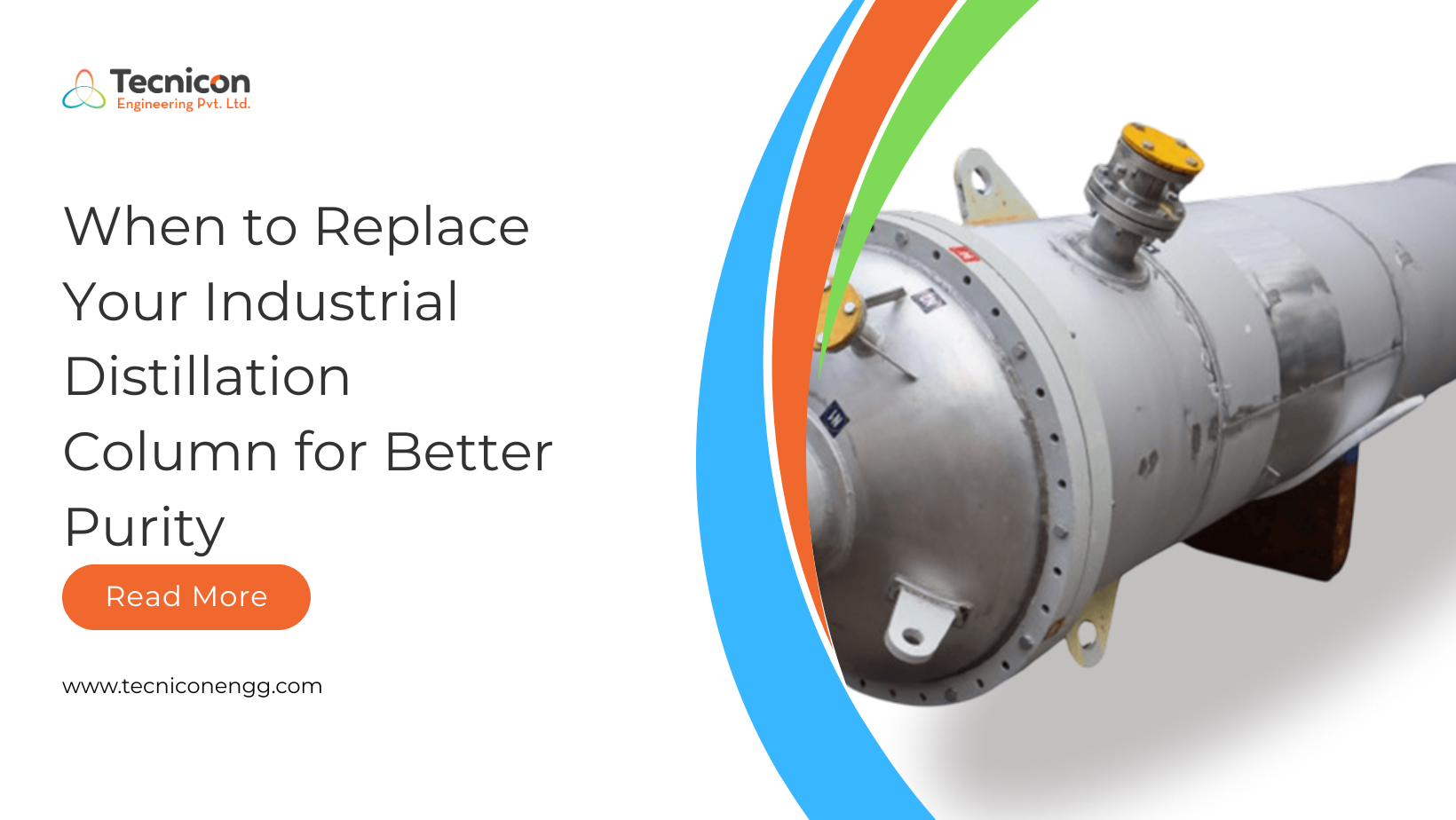
When to Replace Your Industrial Distillation Column for Better Purity
Imagine running a chemical plant at full capacity only to find your product purity slipping, energy costs rising, and output becoming unpredictable. The culprit? An aging or failing distillation column that nobody has assessed in years.
Knowing when to replace your distillation column is one of the most critical decisions in industrial process management. Replacing too early wastes capital. Waiting too long risks product quality, safety, and profitability.
In this guide, you’ll learn the clear warning signs, performance benchmarks, and expert strategies to help you decide whether it’s time to repair or fully replace your industrial distillation column. Whether you operate a refinery, chemical plant, or process facility in India or abroad, this post gives you the practical insight you need.
Why This Topic Matters for Industrial Plant Operators
The Hidden Cost of an Underperforming Column
Industrial distillation column efficiency directly impacts your bottom line. An inefficient column doesn’t just affect product quality, it drives up energy consumption, increases downtime, and puts you at risk of regulatory non-compliance.
In India’s rapidly growing chemical and refinery sectors, distillation column maintenance and replacement decisions are becoming more frequent as older equipment ages and production demands increase.
Why India’s Industry Needs to Pay Attention Now
Many industrial plants across Gujarat, Rajasthan, and Maharashtra are operating columns that were installed 15–25 years ago. As a leading process equipment manufacturer India region relies on, suppliers are seeing a significant rise in demand for column assessment services and upgrades.
The question is no longer if you’ll need to upgrade. its when, and whether you’ll plan it proactively or react to a crisis.
Key Signs Your Distillation Column Needs Replacement
Understanding the signs your distillation column needs replacement early can save your plant from costly emergency shutdowns. Here’s what to watch for:
1. Declining Product Purity Despite Operational Adjustments
This is the most telling signal. If your product purity is consistently below specification even after adjusting reflux ratios, feed rates, and temperatures your column internals may be compromised beyond repair.
Common causes include:
- Corroded or fouled trays that no longer allow proper vapour-liquid contact
- Damaged packing material with reduced surface area
- Channelling in structured packing due to maldistribution
If your distillation column performance issues persist through troubleshooting, it’s time to evaluate replacement.
2. Unacceptable Pressure Drop Across the Column
A gradual increase in pressure drop often signals tray flooding, packing collapse, or severe fouling. High pressure drop:
- Increases energy consumption
- Reduces throughput capacity
- Forces the column to operate outside its design envelope
Regular pressure drop monitoring is a fundamental part of distillation column troubleshooting India engineers rely on.
3. Frequent Unplanned Shutdowns
If your team is scheduling maintenance more than two to three times per year due to column-related failures, you’re spending more on reactive repairs than a planned replacement would cost.
Track your maintenance logs carefully. Recurring issues with weirs, downcomers, distributors, or column shells are strong indicators that a full distillation column repair vs replacement India evaluation is overdue.
4. Severe Corrosion or Mechanical Damage to the Shell
External inspections and internal ultrasonic testing may reveal wall thinning, pitting, or stress fractures in the column shell. When structural integrity is compromised:
- Repairs may only provide short-term relief
- Safety risks escalate significantly
- Insurance and compliance requirements may mandate replacement
A reputable industrial distillation equipment supplier Gujarat or across India will offer inspection services to assess shell condition objectively.
5. Column Design No Longer Matches Process Requirements
Process chemistries evolve. If your production requirements have changed new feedstocks, higher purity targets, increased throughput your original column design may simply be inadequate.
This is especially relevant for chemical plant distillation column India operators who have expanded capacity or shifted product lines in recent years. Retrofitting internals may help, but a full column redesign is sometimes the only viable path to meeting new targets.
6. Energy Consumption Has Risen Significantly
Aging columns lose thermodynamic efficiency. If your reboiler duty or condenser load has increased by more than 10–15% without a corresponding increase in production, your column is likely underperforming internally.
Distillation column efficiency improvement India specialists can conduct energy audits to quantify losses and recommend the most cost-effective corrective action.
Repair vs. Replace: How to Make the Right Decision
One of the most common questions in distillation column maintenance India is: should we repair or replace?
Here is a straightforward comparison to help you decide:
| Factor | Repair | Replace |
| Age of column | Less than 10 years | 15+ years |
| Shell condition | Good, minor issues | Severe corrosion/thinning |
| Purity shortfall | Minor, recoverable | Consistent, significant |
| Energy losses | Marginal | Greater than 15% increase |
| Frequency of shutdowns | Occasional | Frequent (3+ per year) |
| Process requirements | Unchanged | Significantly changed |
| Cost | Lower short-term | Higher upfront, lower long-term |
The rule of thumb: If the cost of repairs exceeds 40–50% of the replacement cost and the column is already aged, replacement almost always delivers better long-term value.
The cost of replacing a distillation column in India varies widely based on material of construction, diameter, height, and internal type, but a structured cost-benefit analysis with your equipment supplier will clarify the decision.
Benefits of Timely Distillation Column Replacement
Proactively replacing your column rather than waiting for failure delivers measurable advantages:
Improved Product Purity and Consistency
A new column with properly designed internals (trays, structured packing, or random packing) ensures stable vapour-liquid equilibrium and consistent separation. This translates directly to higher product quality and fewer batch rejections.
Reduced Energy Consumption
Modern distillation column design India incorporates advanced thermodynamic modelling that can reduce energy usage by 15–30% compared to older column configurations. Lower energy costs directly improve your plant’s operating margins.
Increased Throughput Capacity
New columns can be designed for higher vapour and liquid loads, allowing you to meet growing production targets without building additional units. This is a significant benefit for refinery distillation column India operators facing increasing demand.
Lower Maintenance Burden
A new column with premium internals from a trusted column internals supplier India requires significantly less frequent intervention, reducing your maintenance cost and freeing your team for higher-value activities.
Better Safety and Compliance
New columns are built to current codes and standards (IS, ASME, PED), reducing your liability exposure and simplifying regulatory compliance for chemical processing equipment India audits.
Common Mistakes to Avoid When Evaluating Column Replacement
Even experienced plant managers make avoidable errors during this process. Watch out for:
Mistake 1: Relying Only on Visual Inspection Internal fouling, tray damage, and early corrosion are often invisible from the outside. Always combine visual inspection with ultrasonic testing, gamma scanning, and pressure drop analysis.
Mistake 2: Comparing Only Upfront Costs A cheaper repair that fails in 18 months costs more than a well-engineered replacement. Always evaluate total cost of ownership, including downtime, energy, and repeated maintenance.
Mistake 3: Not Involving a Process Engineer Early Equipment decisions should be driven by process data, not just mechanical inspection. Loop in a process engineer who understands distillation column troubleshooting India practices before finalising any decision.
Mistake 4: Choosing a Supplier Without Proven Experience Your column is a long-term asset. Partner with a distillation column manufacturer India with a strong track record in your specific application whether that’s petrochemical, pharmaceutical, food processing, or specialty chemical.
Expert Tips for Better Distillation Column Performance and Longevity
Whether you’re extending the life of your current column or planning a new one, these tips will help you get the most from your investment:
Tip 1:- Implement a Predictive Maintenance Programme Use pressure drop trending, temperature profiling, and periodic gamma scans to catch performance issues before they become failures. This is the foundation of smart distillation column maintenance India practice.
Tip 2:- Upgrade Internals Before Replacing the Shell If your column shell is in good condition but efficiency has dropped, consider upgrading to high-performance trays or structured packing. A column internals supplier India can often double separation efficiency without a full column replacement.
Tip 3:- Commission a Rigorous Process Simulation Before any replacement or major modification, run a validated simulation (Aspen Plus, HYSYS, or similar) to confirm your new design will meet targets under all expected operating conditions.
Tip 4:- Plan Replacement During Scheduled Turnarounds Timing your column replacement to coincide with planned shutdowns minimises production losses and allows for proper commissioning.
Tip 5:- Work with Local, Experienced Suppliers Partnering with an industrial distillation equipment supplier Gujarat or India-based specialist means faster lead times, easier site access, and better after-sales support all critical for minimising project risk.
Conclusion:-
Recognising when to replace your distillation column is not just a maintenance decision it’s a strategic one. The signs are clear: declining purity, rising energy costs, frequent shutdowns, shell damage, or a mismatch between your column’s design and your current process requirements.
Delaying action only compounds the problem. The cost of unplanned downtime, off-spec product, and emergency repairs almost always exceeds the cost of a well-planned replacement.
Key Takeaways:
- Monitor purity, pressure drop, and energy consumption continuously
- Use a structured repair-vs-replace framework to make objective decisions
- Involve process engineers and trusted suppliers early
- Time replacements with planned turnarounds to minimise disruption
- Partner with experienced, India-based manufacturers for faster, cost-effective execution
Ready to Assess or Replace Your Distillation Column?
If you’re seeing any of the warning signs discussed in this guide, don’t wait for a failure to force your hand. Work with experts who understand the full picture from process simulation and column design to fabrication, installation, and commissioning.Tecnicone Engineering to explore their full range of industrial distillation equipment, column internals, and process engineering solutions. Whether you need a complete replacement column, upgraded internals, or an expert assessment of your existing system, their experienced team is ready to help you achieve better purity, higher efficiency, and lower operating costs.

Kishan Patel is the Founder & CEO of Tecnicon Engineering Pvt. Ltd., specializing in manufacturing advanced process equipment for industries like chemicals, pharmaceuticals, and petrochemicals. He is passionate about innovation, quality engineering, and delivering reliable industrial solutions.