
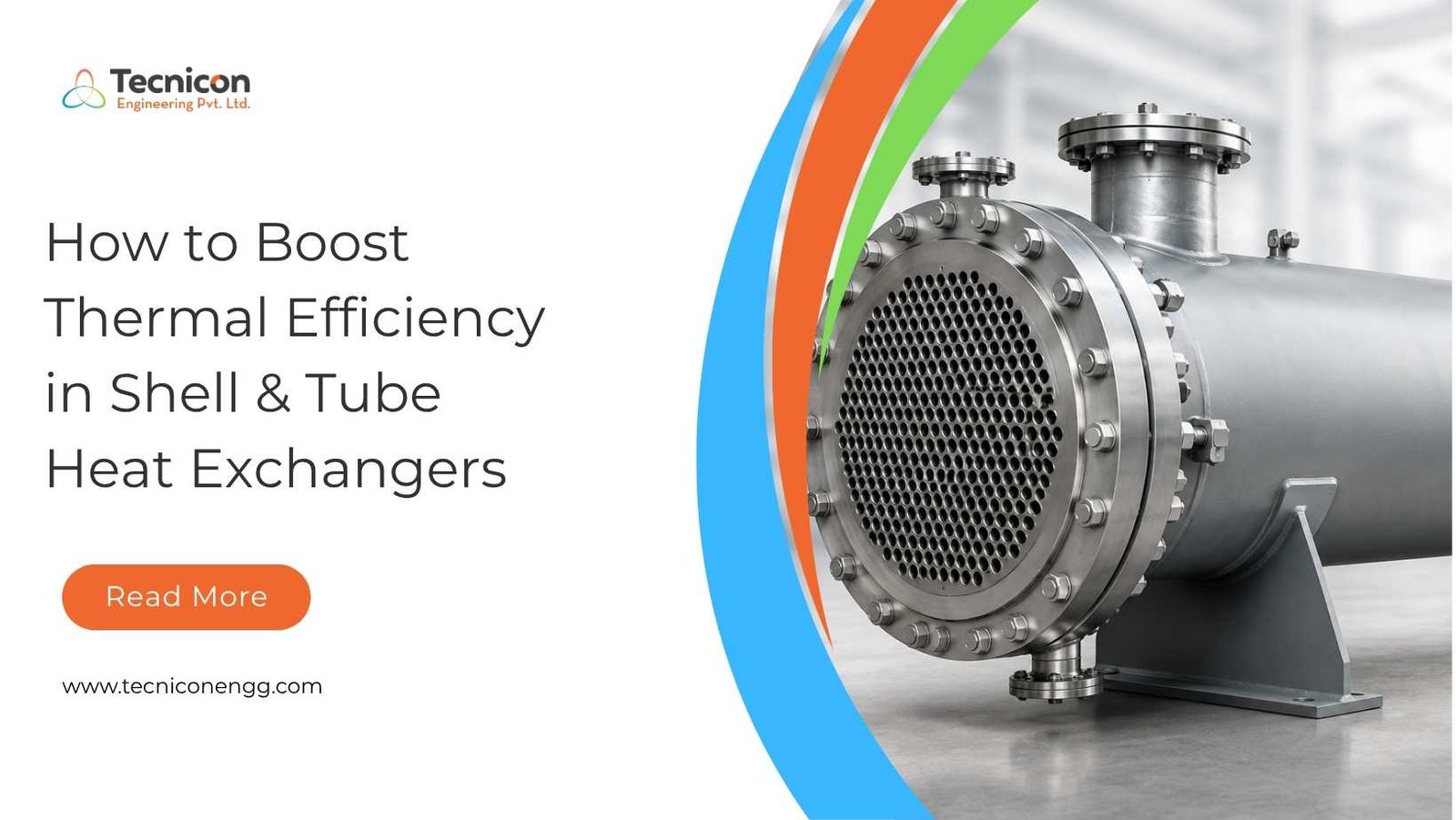
How to Boost Thermal Efficiency in Shell & Tube Heat Exchangers
Thermal efficiency in a shell and tube heat exchanger depends on how well heat moves from one fluid to another across the tube wall, and how consistently that transfer happens over months of operation. A unit that performs well on day one can lose a significant share of its capacity within a year if fouling, poor flow distribution, or incorrect sizing go unaddressed. This guide covers the practical factors that influence heat exchanger thermal efficiency and the steps plant teams can take to keep performance close to design levels.
What Determines Thermal Efficiency in a Shell and Tube Heat Exchanger
Thermal efficiency comes down to how effectively heat is transferred per unit of surface area, for a given flow rate and temperature difference. Several variables affect this directly:
- Tube material and wall thickness, which affect conductive resistance
- Flow velocity and turbulence on both the shell side and tube side
- Fouling buildup on internal and external surfaces
- Baffle spacing and configuration, which control shell side flow pattern
- Temperature difference between the two fluids (the driving force for heat transfer)
- Correct sizing for the actual process duty, not just a generic catalog selection
When any of these fall out of an optimal range, overall heat transfer coefficient drops, and the exchanger needs a larger temperature difference or more surface area to move the same amount of heat.
Common Causes of Reduced Efficiency
Fouling
Fouling is one of the most common reasons a shell and tube heat exchanger underperforms over time. Scale deposits, biological growth, corrosion products, or process residue build up on tube surfaces and act as an insulating layer, reducing the effective heat transfer coefficient. Even a thin fouling layer can noticeably increase pressure drop and cut thermal performance, since the deposit resists heat flow far more than the metal tube wall itself.
Fouling rates depend heavily on fluid chemistry, temperature, and velocity. Water with high mineral content, for example, tends to scale faster at higher wall temperatures, while low velocity zones allow particulates to settle rather than get carried through the unit.
Poor Flow Distribution
If fluid does not distribute evenly across all tubes, some tubes carry more flow than others, creating uneven heat transfer and localized hot or cold zones. This often results from inlet nozzle placement, damaged or misaligned baffles, or tube bundle designs that were not matched to the actual flow conditions.
Incorrect Sizing
An exchanger sized for one process condition but operated under a different flow rate, temperature range, or fluid composition will rarely perform at its rated efficiency. Oversized units can run at low velocities that encourage fouling, while undersized units struggle to reach the required outlet temperature at all.
Practical Ways to Improve Thermal Efficiency
Maintain a Regular Cleaning and Inspection Schedule
Since fouling accumulates gradually, scheduled cleaning, whether mechanical brushing, chemical cleaning, or hydroblasting, keeps the heat transfer surface closer to its original condition. Inspection intervals should be based on the specific fouling tendency of the process fluids rather than a fixed calendar date, since some services foul far faster than others.
Optimize Flow Velocity
Increasing velocity within the tube manufacturer’s recommended range improves turbulence, which raises the heat transfer coefficient and helps keep particulates from settling on tube walls. Velocity that is too high, however, can cause erosion, especially at tube inlets, so this needs to stay within the limits set for the tube material and fluid being handled.
Review Baffle Design
Baffle spacing and cut orientation control how the shell side fluid moves across the tube bundle. Baffles spaced too far apart allow flow to bypass sections of the bundle, reducing effective contact with the tube surface. Adjusting baffle configuration during a rebuild or retrofit can meaningfully improve shell side heat transfer without changing the overall exchanger footprint.
Select the Right Tube Material and Configuration
Tube material affects both conductive performance and corrosion resistance, which in turn affects long-term fouling behavior. Stainless steel tubes are common in chemical and pharmaceutical services for their corrosion resistance, while finned tubes can increase effective surface area in services where one fluid has a much lower heat transfer coefficient than the other.
Monitor Performance Against Design Data
Comparing actual operating temperatures, flow rates, and pressure drop against original design data helps identify performance drift early. A gradual rise in pressure drop at constant flow rate is often one of the earliest indicators of fouling, well before outlet temperature shows a noticeable change.
Design for the Actual Process, Not a Generic Standard
Heat exchangers designed around the specific fluid properties, flow rates, and fouling tendencies of a process consistently outperform generic, catalog-sized units. Working with a manufacturer that reviews actual process data during the design phase reduces the risk of chronic underperformance from day one.
Conclusion
Thermal efficiency in a shell and tube heat exchanger is not a fixed number set at installation. It is influenced by ongoing factors like fouling, flow distribution, and how closely the unit’s operating conditions match its original design basis. Regular cleaning, correct velocity management, sound baffle design, and proper material selection all contribute to keeping performance close to design values over the exchanger’s service life.
If your current heat exchanger is falling short of its expected thermal performance, or you are specifying a new unit for a demanding process, working with an experienced heat exchanger manufacturer can help match the design to your actual operating conditions rather than a standard catalog spec. Tecnicon Engineering designs and fabricates shell and tube heat exchangers in Ahmedabad, Gujarat, for chemical, pharmaceutical, and process industries, and can help evaluate the right configuration for your application.