
How to Select the Right Heat Exchanger for an Industrial Process
The right heat exchanger for an industrial process is the one that meets your required heat duty within the allowed pressure drop, uses materials compatible with both fluids, and can be cleaned and maintained in your operating conditions. Heat exchanger selection begins with process data: fluids, flow rates, temperatures, pressures, and fouling tendencies. Equipment type, size, and material follow from that data.
the main factors, compares common types, and shows what to check when choosing a heat exchanger manufacturer for chemical and process plants.
What Does a Process Heat Exchanger Do?
A process heat exchanger transfers thermal energy between two fluids without mixing them. It may heat a cold stream, cool a hot stream, condense vapor, or boil a liquid. Industrial heat transfer equipment of this kind appears in chemical plants, pharmaceuticals, food processing, power, and oil and gas.
Typical duties include cooling reactor outputs, condensing solvent vapors, preheating feed, and recovering waste heat to improve thermal efficiency.
Start with Process Requirements
Before comparing designs, gather the following:
- Fluids on each side: Composition, density, viscosity, specific heat, and thermal conductivity
- Flow rate: For both hot and cold streams
- Inlet temperature and outlet temperature: Target values for each stream
- Heat duty: The amount of heat to be transferred, calculated from flow rate, specific heat, and temperature change
- Operating temperature and pressure: Along with design margins
- Allowable pressure drop: On each side
- Fouling conditions: Whether fluids deposit scale, polymers, or solids
- Corrosiveness: Of both process fluids and utility media
Incomplete data is one of the most common causes of poor heat exchanger design. A detailed data sheet allows accurate sizing and avoids over- or under-design.
Common Types of Industrial Heat Exchangers
Shell and Tube Heat Exchanger
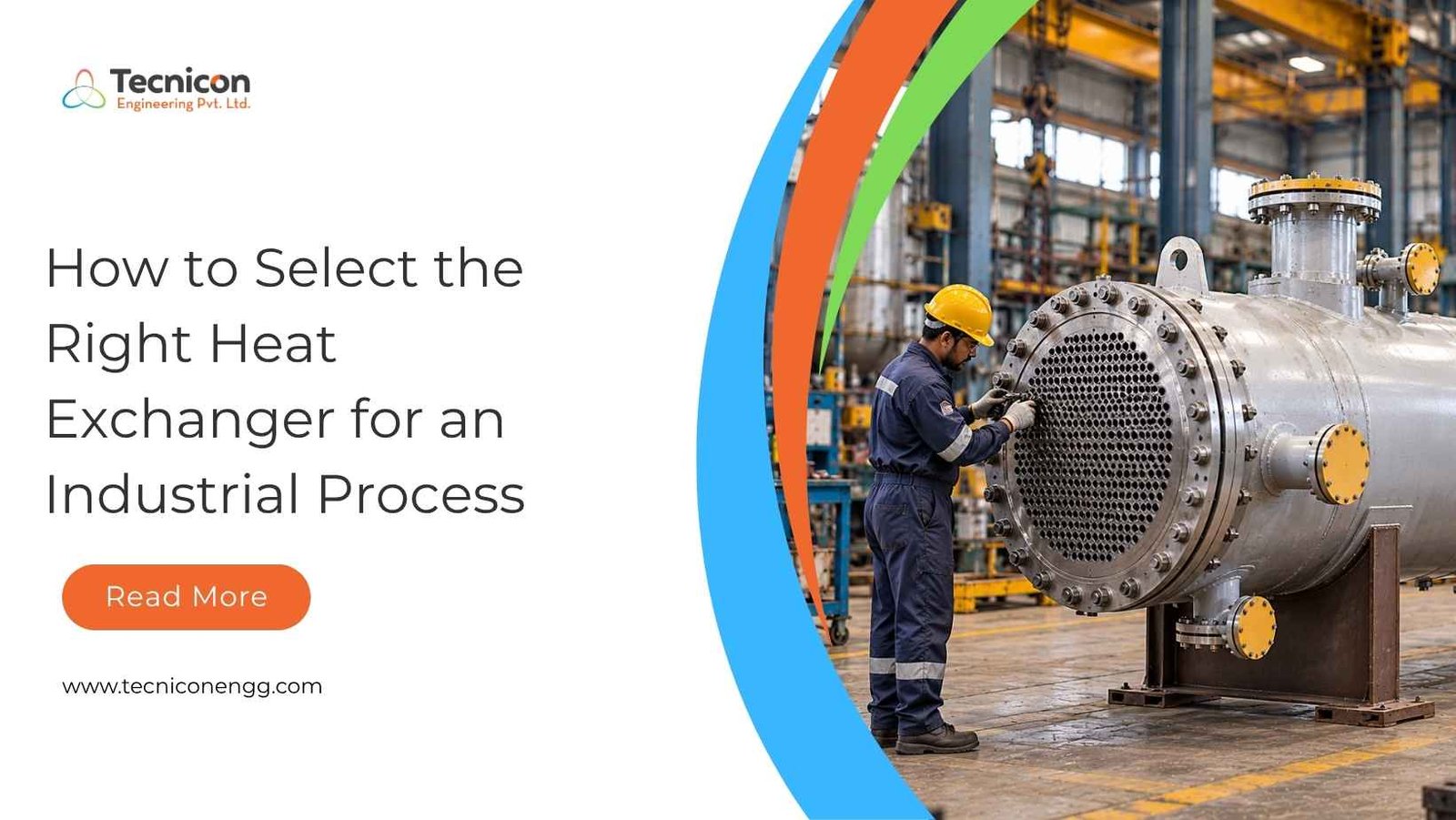
The shell and tube heat exchanger is the most widely used type in process industries. A tube bundle sits inside a cylindrical shell, with one fluid flowing through the tubes and the other around them. It handles high pressures and temperatures, tolerates a wide range of fluids, and is available in fixed tubesheet, U-tube, and floating head forms.
It suits condensers, reboilers, coolers, and general process duties. Floating head and U-tube designs are preferred where thermal expansion is significant or the tube bundle needs regular cleaning.
Plate Heat Exchanger
Plate units pack corrugated plates in a frame and offer high heat transfer coefficients in compact space. They suit clean fluids at moderate pressures and temperatures, but gasket limits restrict their use with aggressive chemicals or very high pressure.
Double Pipe and Other Types
Double pipe exchangers work for small duties and high pressures. Air-cooled exchangers suit locations where cooling water is scarce. Spiral and plate-and-shell designs address viscous or fouling fluids in specialized cases.
| Type | Best For | Limitation |
| Shell and tube | High pressure, high temperature, wide fluid range | Larger footprint |
| Plate | Clean fluids, compact space, close temperature approach | Gasket and pressure limits |
| Double pipe | Small duties, high pressure | Poor scalability |
| Air-cooled | Water-scarce sites | Large area, lower efficiency |
Material Selection and Corrosion Resistance
Material selection affects service life, product purity, and cost. Check compatibility for the shell side, tube side, tubesheets, and gaskets.
- Carbon steel: Economical for non-corrosive services
- Stainless steel (304, 316): Common for chemical, hygienic, and moderately corrosive duties
- Special alloys or titanium: For highly corrosive or chloride-rich services
Cooling water quality also matters. Poor quality water can cause scaling and pitting, so confirm material grades against your actual fluids rather than general guidelines.
Sizing: Heat Transfer Area and Pressure Drop
Heat exchanger size depends on the required duty, the temperature difference between streams, and the overall heat transfer coefficient. The basic relationship is Q = U × A × ΔT, where Q is heat duty, U is the overall heat transfer coefficient, A is heat transfer surface area, and ΔT is the log mean temperature difference.
A larger area allows more heat transfer but increases cost and may lower velocity, which encourages fouling. Higher velocity improves heat transfer but raises pressure drop and pumping cost. Good design balances these effects. Designers often add a margin on area to allow for fouling, though excessive margin can cause operating problems.
Fouling, Cleaning, and Maintenance
Fouling reduces heat transfer and raises pressure drop over time. Place fouling fluids on the tube side where possible, since tubes are easier to clean mechanically. Use removable bundles or accessible designs when frequent cleaning is expected, and specify suitable tube layouts, such as square pitch, for easier access.
Pressure and Temperature Conditions
The exchanger is also a pressure-containing equipment, so mechanical design must comply with recognized codes such as ASME Section VIII or TEMA standards for shell and tube units. Check the design pressure and temperature on both sides, as well as upset, startup, and vacuum conditions.
Choosing a Heat Exchanger Manufacturer in India
Design capability, fabrication quality, and testing matter as much as thermal performance. When evaluating a heat exchanger manufacturer in India, look for:
- In-house thermal and mechanical design capability
- Experience with shell and tube heat exchangers and your type of service
- Qualified welding procedures and tube-to-tubesheet joint expertise
- Hydrostatic testing and inspection facilities
- Complete documentation, including drawings, calculations, and material certificates
Gujarat is one of India’s main chemical and engineering regions, so a heat exchanger manufacturer in Ahmedabad or a shell and tube heat exchanger supplier in Gujarat is often close to the plants that need this equipment. This can simplify design discussions, workshop inspections, and after-sales support. For chemical plants, ask for references from similar services before choosing a custom heat exchanger manufacturer in India.
Conclusion
Selecting the right heat exchanger comes down to clear process data, the right equipment type, suitable materials, correct sizing, and a plan for cleaning and maintenance. Shell and tube designs remain the most versatile choice for demanding industrial duties, while other types fit specific needs such as compact installation or clean service.
Define heat duty, temperatures, pressure drop, and fouling conditions early, and confirm the design against the applicable code. When you are ready to discuss your requirements, connect with tecniconengg for an engineered heat exchanger solution suited to your process.