
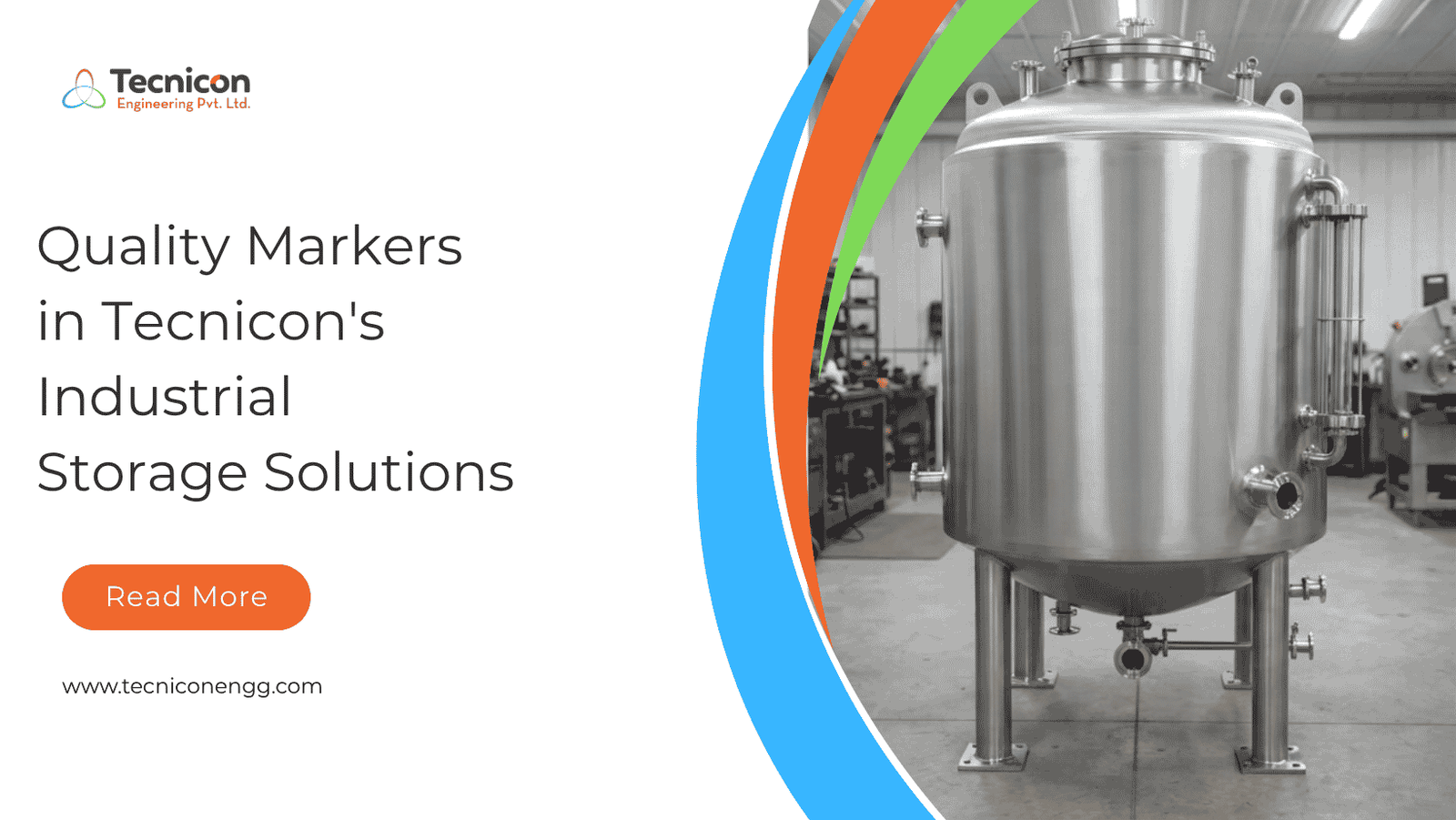
Top 5 Quality Markers in Tecnicon’s Industrial Storage Solutions
Every storage tank looks roughly the same from a distance: a tall cylindrical vessel sitting quietly on a plant floor. But underneath that simple shape, quality varies enormously between manufacturers, and that variation shows up as leaks, corrosion, and costly downtime years down the line.
Choosing the right industrial storage tank manufacturer is not just a procurement decision. It’s a safety and reliability decision that affects everything the tank touches, from raw material integrity to regulatory compliance.
This article walks through the five quality markers that genuinely separate dependable industrial storage solutions from tanks that look fine on paper but fail in real world operating conditions.
Why Quality Markers Matter More Than Price
A storage tank is a long term asset, often expected to run for fifteen years or more without major intervention. A quote that looks attractive today can turn expensive fast if the tank develops corrosion, weld failures, or capacity issues within its first few years.
That’s why experienced buyers evaluate a storage tank manufacturer on documented quality markers, not just price per liter of capacity. The right markers tell you whether a tank was engineered for your specific application or simply built to a generic template.
Marker 1: Material Grade and Corrosion Resistance
The single biggest driver of a tank’s service life is the material it’s made from. For most chemical, pharmaceutical, and food grade applications, that means choosing the correct stainless steel grade for the stored medium.
SS304 and SS304L are common choices for general industrial storage, offering solid corrosion resistance at a moderate cost. SS316 and SS316L, which contain molybdenum, hold up significantly better against chlorides and aggressive chemical environments, which is why they’re the standard choice for pharmaceutical and specialty chemical storage.
A reputable stainless steel storage tank supplier will ask detailed questions about what the tank will actually store before recommending a grade, rather than defaulting to whatever is cheapest to source that month.
Pro tip: Always request the mill test certificate for the specific steel coil or plate used in your tank, not a generic grade specification sheet. It confirms the actual chemical composition of the material in your vessel.
Marker 2: Welding Standards and Fabrication Process
A tank is only as strong as its welds. Poor welding is one of the leading causes of premature tank failure, and it’s often invisible until a leak or crack appears months or years later.
Quality fabricators follow documented welding procedures, use qualified welders, and apply consistent quality checks throughout the process, not just at final inspection. Look for:
- Welder qualification records specific to the material and thickness being joined
- Consistent bead quality with no visible undercutting or porosity
- Proper post weld treatment, including passivation for stainless steel vessels
- In house fabrication rather than fully outsourced welding work
In house welding matters more than buyers often realize. When design, fabrication, and testing happen under one roof, accountability for quality stays with a single team instead of being split across subcontractors.
Marker 3: Design Engineering and Structural Calculations
A well engineered tank accounts for far more than just holding a certain volume of liquid. Wind load, seismic considerations, foundation design, and internal pressure from the stored medium all factor into a proper structural calculation.
Modern fabricators increasingly use finite element analysis, or FEA, to model stress distribution across the tank shell and support structure before fabrication even begins. This catches design weaknesses on a computer screen instead of on the plant floor.
For industrial storage vessels operating in regions with specific environmental conditions, this kind of engineering diligence is what prevents structural issues that generic, catalog based tank designs often miss.
Marker 4: Testing, Certification, and Documentation
Documentation might seem like a paperwork formality, but it’s one of the clearest signals of manufacturing discipline. A manufacturer that skips or rushes testing on the shop floor is more likely to skip other quality steps too.
| Test or Certification | What It Confirms |
| Hydrotest | Tank holds pressure and shows no leaks under test conditions |
| Radiography testing (RT) | Weld integrity below the visible surface |
| Dye penetrant testing (DPT) | Surface level cracks or weld defects |
| Material test certificate | Confirms actual chemical composition of steel used |
| ISO 9001:2015 certification | Consistent, documented quality management processes |
Before finalizing an order, ask your industrial storage tank manufacturer in India for sample test reports from a comparable past project. It’s a quick way to confirm their documentation practices match what they promise in the sales conversation.
Marker 5: Customization for Application Specific Needs
No two plants store identical materials under identical conditions, so a genuinely high quality manufacturer treats every tank as a custom engineering project rather than a catalog item.
This includes tailoring nozzle placement, agitation requirements, insulation, heating or cooling jackets, and internal coatings to the specific product being stored. A custom storage tank manufacturer should be comfortable adjusting these details based on your process, not asking you to adapt your process to their standard design.
Vertical tanks remain the most common configuration for space efficient bulk storage, but horizontal tanks, insulated tanks, and pressure rated storage vessels each serve specific operational needs that a one size fits all approach simply cannot meet.
How Stainless Steel Storage Tanks Improve Industrial Safety
Beyond product quality, storage tank design has a direct impact on plant safety. Corrosion weakened shells, poorly designed nozzles, and inadequate venting are common contributors to industrial incidents involving stored liquids.
Stainless steel’s corrosion resistance reduces the risk of unexpected material failure over time, while proper structural engineering ensures the tank can safely withstand its actual operating loads, not just the loads assumed in a generic design template. Combined with routine inspection, these factors are what keep storage tanks operating safely well past their first decade in service.
Why Ahmedabad Is a Trusted Hub for Storage Tank Fabrication
Gujarat’s long standing concentration of chemical, pharmaceutical, and process equipment manufacturing has made Ahmedabad a natural center for tank fabrication, supported by an established base of skilled welders, testing labs, and raw material suppliers.
That’s part of why buyers increasingly search for a storage tank manufacturer in Ahmedabad rather than sourcing from distant, less specialized fabricators. Working with a process equipment manufacturer in Ahmedabad typically means shorter lead times, more accessible factory inspections, and simpler logistics for large or heavy vessels that are costly to transport across the country.
For buyers searching for a storage tank manufacturer near me in western India, a locally based, vertically integrated fabricator in this region often provides the most practical combination of engineering quality and project turnaround.
Conclusion
The tanks that hold up for decades and the tanks that fail early rarely differ in outward appearance. The difference lies in material selection, welding discipline, engineering rigor, documented testing, and a willingness to customize the design around your actual process.
When evaluating an industrial storage tank manufacturer, look past the quote and ask about these five markers directly. A supplier confident in their quality process will have clear, specific answers ready, not vague reassurances.