
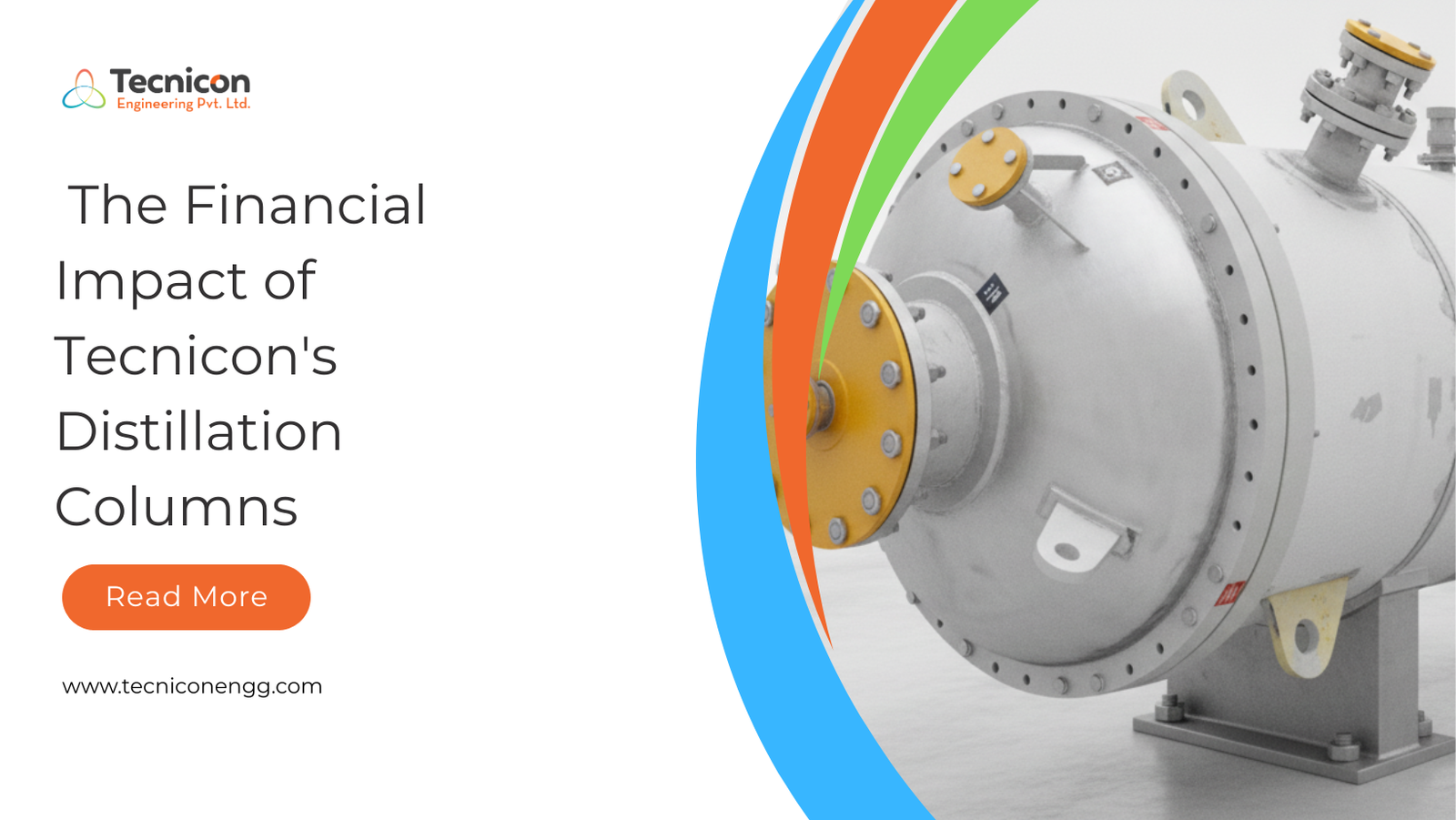
Measuring ROI: The Financial Impact of Tecnicon’s Distillation Columns
Most plant managers evaluate a distillation column on specs alone: diameter, tray count, material grade. Few stop to calculate what that equipment actually returns on the capital spent.
That’s a mistake. A distillation column is one of the most capital intensive assets on a chemical processing floor, and its design quality directly affects energy bills, downtime, and product recovery rates for years after installation.
This article breaks down how to think about ROI when evaluating a distillation column manufacturer, what financial levers a well engineered column actually pulls, and why so many Indian manufacturers are now searching for a distillation column manufacturer in Ahmedabad instead of settling for generic, off the shelf equipment.
Why ROI Matters More Than Sticker Price
A cheaper column often looks attractive on a purchase order. But the real cost of any industrial separation column shows up over its operating life, not on day one.
Energy consumption, maintenance frequency, product losses, and unplanned downtime all compound over a ten to fifteen year equipment lifespan. A column priced 15% lower upfront can easily cost more within three to five years if it runs less efficiently.
That’s why serious buyers now frame the purchase decision around total cost of ownership instead of upfront price. It’s a more accurate lens, and it’s the one lenders and finance teams increasingly expect to see in capex justifications.
The Real Cost Drivers Behind Industrial Distillation Columns
Before calculating ROI, it helps to understand where the money actually goes once a column is running.
- Energy input at the reboiler. This is usually the single largest recurring operating cost, since vaporizing the feed mixture requires continuous heat input.
- Reflux ratio inefficiency. Poorly designed internals force higher reflux ratios to hit purity targets, which burns more energy per unit of product.
- Downtime for cleaning and maintenance. Fouling, tray damage, or corrosion all interrupt production schedules.
- Product loss through poor separation. Every percentage point of lost yield is direct revenue left on the table.
- Material degradation. Corrosion driven replacement of trays, packing, or shell sections adds unplanned capital expense.
Each of these is influenced heavily by how the column was engineered in the first place, not just how it’s operated day to day.
How High Efficiency Distillation Columns Reduce Operational Costs
Think of a distillation column like a car engine. Two engines can produce the same horsepower on paper, but one burns noticeably less fuel because of better internal design.
The same logic applies to industrial distillation columns. Efficient tray or packing design increases vapor liquid contact without demanding a higher reflux ratio, which lowers reboiler energy consumption for the same separation result.
Better internals also mean fewer theoretical stages are needed to hit a purity target, which can reduce column height and, in turn, structural and installation costs. Small design decisions at the engineering stage translate directly into recurring savings once the plant is operational.
Pro tip: Ask your supplier to model expected reflux ratio and energy consumption at your specific feed composition, not just at standard test conditions. Real world feed variability changes the math significantly.
Stainless Steel vs. Carbon Steel: A Cost Comparison
Material selection is one of the biggest ROI decisions buyers make, and one of the most commonly underestimated.
| Factor | Carbon Steel Column | Stainless Steel Column |
| Upfront cost | Lower | Higher, typically 20 to 40% more |
| Corrosion resistance | Limited, needs coatings | High, minimal coating needed |
| Expected service life | Shorter in corrosive service | Significantly longer |
| Maintenance frequency | Higher | Lower |
| Product purity risk | Higher, from scaling or contamination | Lower |
| Resale or retrofit value | Lower | Higher |
A stainless steel distillation column manufacturer will typically quote a higher initial price. But for corrosive feedstocks common in chemical and pharma processing, the lower maintenance burden and longer service life usually recover that premium well within the equipment’s operating life.
Common Mistakes That Erode ROI
Even well funded projects lose money on distillation equipment through avoidable errors.
- Choosing based on upfront quote alone without modeling lifecycle energy and maintenance costs.
- Undersizing the column for future capacity needs, forcing a costly retrofit within a few years.
- Ignoring feed variability during design, which leads to inefficient operation outside narrow test conditions.
- Selecting the wrong tray or packing type for the specific separation duty, sacrificing efficiency for a lower quote.
- Skipping documented testing such as hydrotesting or radiography, which raises the risk of costly failures later.
What to Ask a Distillation Column Manufacturer Before You Buy
A financially sound purchase decision starts with the right questions, not just the lowest bid.
- Can you provide energy consumption estimates specific to my feed composition and purity targets?
- What is the expected maintenance interval and typical lifespan for this material and service?
- Do you offer in house fabrication, welding, and testing, or is work subcontracted?
- What certifications and material test certificates come with the column?
- Can the design accommodate future capacity expansion without a full rebuild?
A capable distillation plant equipment supplier should answer these clearly, with data, rather than pointing you back to a generic catalog spec.
Why Ahmedabad Has Become a Hub for Process Equipment Manufacturing
Gujarat’s chemical and pharmaceutical manufacturing base has made Ahmedabad a natural center for process equipment fabrication, supported by a dense supply chain of raw materials, skilled welders, and testing facilities.
This is part of why demand for a distillation plant manufacturer in Ahmedabad has grown steadily among buyers across India. Working with a process equipment manufacturer in Gujarat often means shorter lead times, easier factory inspections, and simpler logistics, especially for oversized vessels that are expensive to transport long distances.
For buyers searching for a distillation column manufacturer near me, a locally based, vertically integrated fabricator in this region typically offers a practical balance between engineering depth and project turnaround time.
Conclusion
A distillation column should be evaluated the way any major capital asset is evaluated, on total cost of ownership rather than sticker price alone. Energy efficiency, material selection, and engineering quality are the real levers that determine whether a column pays for itself in three years or ten.
Working with an experienced distillation column manufacturer that can model these numbers upfront, rather than after installation, is what separates a sound capital decision from an expensive lesson. If you are comparing options for a distillation column manufacturer in Ahmedabad, ask for lifecycle cost projections before you compare quotes.