
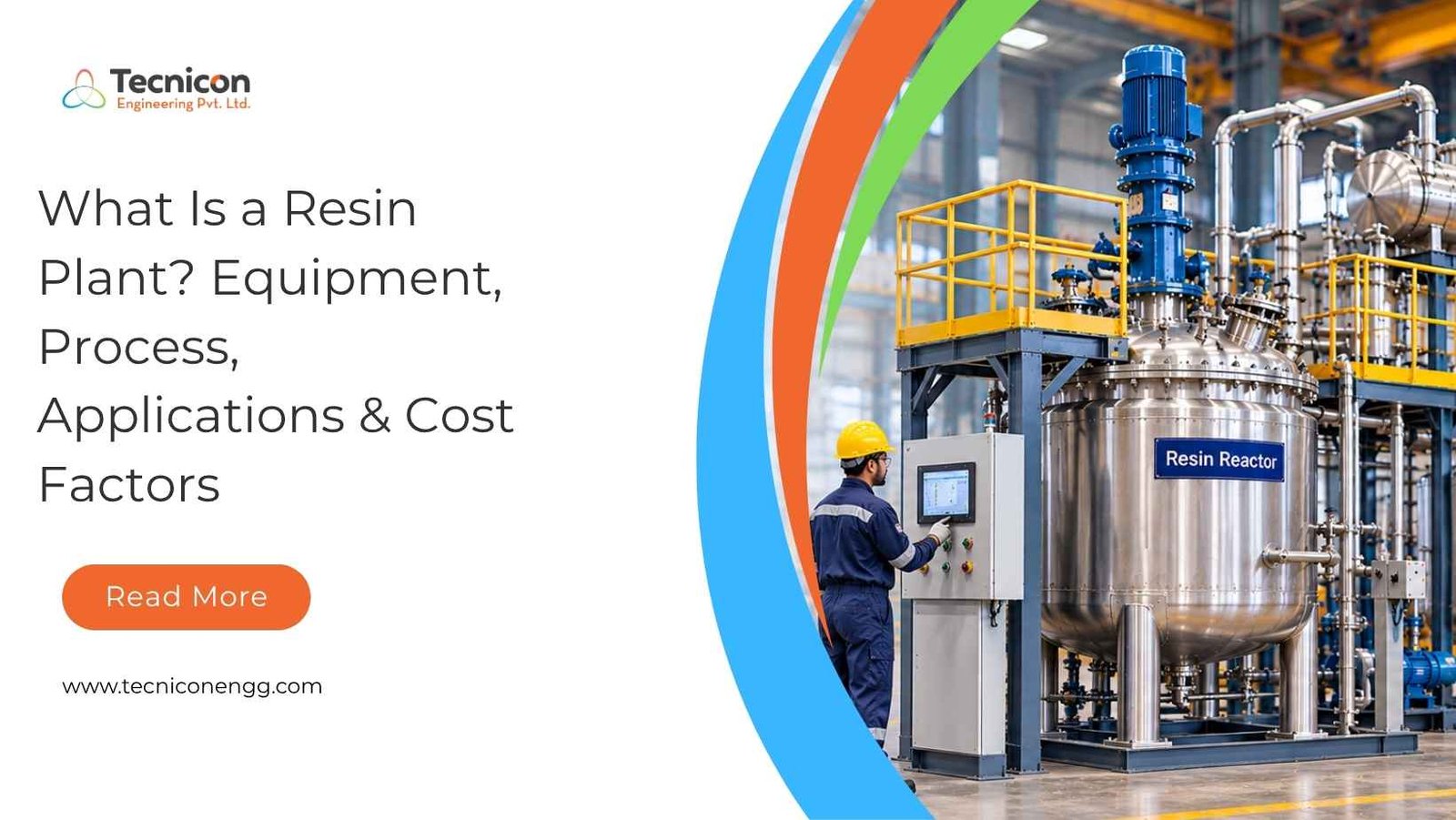
What Is a Resin Plant? Equipment, Process, Applications & Cost Factors
Thinking of starting a resin business in India? The plant you choose will decide your product quality, your running cost, and your profit for the next 10-15 years.
Paints, adhesives, coatings, and composites all start with resin, and resin starts in a resin plant. how an industrial resin plant works, what resin plant equipment it needs, and what affects the cost, in simple language.
What Is a Resin Manufacturing Plant?
A resin manufacturing plant is a chemical resin plant where raw materials like acids, alcohols, monomers, and solvents react under controlled heat and pressure to form resin.
The heart of the plant is a polymerization reactor system. Around it sit condensers, mixing tanks, a vacuum unit, and storage tanks. Most plants run batch resin production, which allows different grades from the same setup.
Common Types of Resin Plants
Epoxy Resin Plant
An epoxy resin plant manufacturer builds systems for coatings, flooring, and adhesives.
Polyester Resin Plant
Used for FRP, laminates, and powder coatings.
Alkyd Resin Plant
Used for paints, enamels, and varnishes. This is the most common setup for the paint and coating industry.
How Does a Resin Production Plant Work?
The resin manufacturing process follows five simple steps.
Step 1: Raw Material Handling
Raw materials are weighed and charged as per the resin formulation. Accurate raw material composition keeps product consistency high.
Step 2: Polymerization
Inside the resin reactor vessel, the chemical reaction process begins. The agitator mixes the batch while the heating system holds the correct reaction temperature. Reaction time depends on the resin type.
Step 3: Condensation and Vacuum
By-products like water are removed by the condenser and reboiler system. The vacuum system for resin production helps complete the reaction and control resin viscosity.
Step 4: Blending and Filtration
The resin moves to a resin blending tank for thinning, then through resin filtration equipment before going to the resin storage tank.
Step 5: Quality Control
Each batch is tested for viscosity, acid value, solid content, and color. Strong resin quality control means fewer customer complaints and repeat orders.
Key Equipment in a Resin Plant
Reactor Vessel
A stainless steel reactor vessel is sized for your reactor vessel capacity, operating pressure, and temperature range. Jacketed or coil designs support better heat transfer.
Mixing Tank with Agitator
Agitator speed and blade design are chosen based on resin thickness, giving uniform mixing efficiency.
Heat Transfer System
Thermic fluid or steam heating keeps temperature stable and improves heat transfer efficiency, which lowers energy consumption.
Condenser Unit
Recovers solvents and by-products so nothing is wasted.
Automation and Control
A modern temperature control system and plant automation (PLC-based) improve safety, repeatability, and production efficiency.
Where Are Resin Plants Used?
A resin processing plant supplies many industries:
- Paint and coating industry: Decorative and protective finishes
- Adhesive manufacturing: Wood, packaging, and industrial bonding
- Construction: Flooring, sealants, and waterproofing
- Composites: Pipes, tanks, and panels
Resin Plant Setup Cost in India: What Affects the Price?
There is no fixed price. The resin plant setup cost in India depends on these factors:
Production Capacity
Higher resin production capacity needs bigger reactors, utilities, and storage.
Resin Type
Epoxy, polyester, and alkyd plants differ in temperature, vacuum, and material needs.
Material of Construction
Stainless steel costs more than mild steel but gives better corrosion resistance and product purity.
Automation Level
Higher upfront cost, but lower labor cost and better batch consistency over time.
Utilities and Safety
Boiler or thermic fluid heater, cooling tower, vacuum pump, fire protection, and explosion-proof fittings are needed to meet industrial safety standards. These also shape your production operating cost.
Installation and Commissioning
Piping, foundation, equipment installation, and trial runs should be part of your budget from day one.
Why Gujarat Is a Strong Choice for Resin Plant Fabrication
Gujarat is one of India’s leading chemical and engineering hubs. If you are looking for a resin plant manufacturer in Ahmedabad or an industrial resin plant supplier in Gujarat, you benefit from:
- Skilled fabrication workshops and quick access to raw materials
- Strong supply chain for stainless steel and process equipment
- Close reach to paint, adhesive, and chemical industries in Gujarat, Maharashtra, and Rajasthan
- Easy transport to buyers across India
How to Choose the Right Resin Plant Manufacturer
When comparing a resin plant manufacturer in India, check for:
- Experience in resin plant design and fabrication
- Custom resin manufacturing plant options built around your formulation
- Turnkey resin plant solution covering design, installation, and commissioning
- Quality certificates and inspection records
- After-sales support and operator training
FAQs
What equipment is required for a resin manufacturing plant?
A reactor with agitator, condenser, heating system, vacuum unit, blending tank, filtration unit, and storage tanks.
How does a resin production plant work?
Raw materials react in a heated reactor, by-products are removed under vacuum, and the finished resin is blended, filtered, and stored.
How to set up an industrial resin manufacturing plant?
Define your resin type and capacity, finalize the formulation, select a reliable manufacturer, arrange utilities and safety approvals, then complete installation and trial runs.
Which is better, batch or continuous production?
Batch suits multiple grades. Continuous suits high-volume, single-grade output.
Conclusion
A good resin plant combines the right reactor, strong heat transfer, reliable vacuum, and smart automation. Choose an experienced turnkey resin plant manufacturer in India, share your formulation and capacity, and get a plant built for your actual needs.