
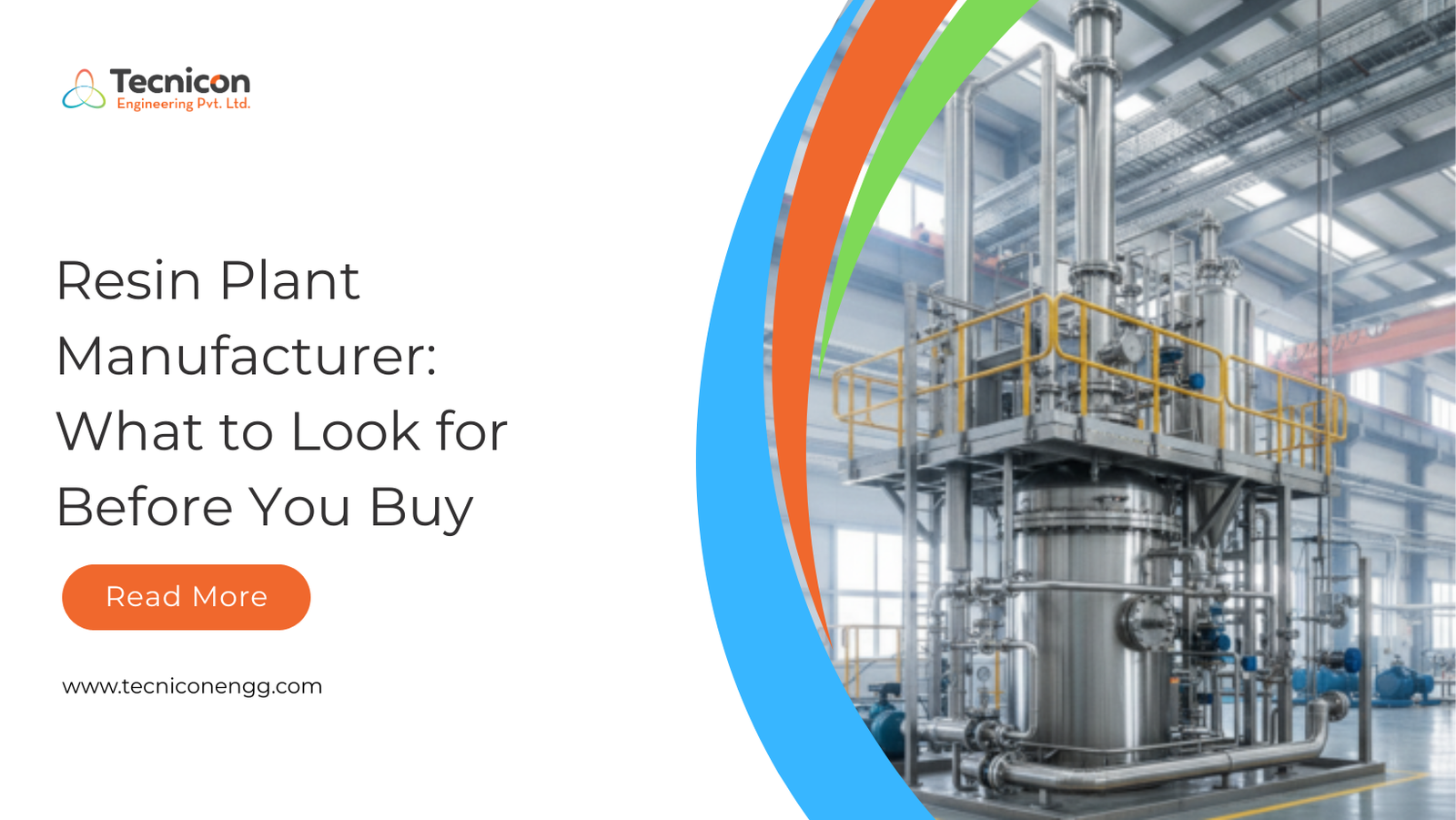
Resin Plant Manufacturer: What to Look for Before You Buy
If you’ve ever walked a paint or adhesives factory floor, you know the resin reactor is the heart of the operation. Everything downstream viscosity, cure time, batch consistency depends on how well that vessel was engineered.
That’s exactly why choosing the right resin plant manufacturer is one of the highest-stakes decisions a process engineer or plant head will make. Get it wrong, and you’re looking at inconsistent batches, unplanned downtime, and safety headaches for the next decade.
This guide breaks down how resin plants actually work, what separates a well-built system from a mediocre one, and how to evaluate a resin plant manufacturer in Ahmedabad or anywhere else in India before you sign a purchase order.
What Is an Industrial Resin Plant?
An industrial resin plant is a complete batch or semi-batch manufacturing unit built to produce synthetic resins alkyd, epoxy, polyester, acrylic, or phenolic under tightly controlled temperature and pressure.
It isn’t just a single vessel. A proper plant integrates a reactor, condenser, distillation column, receiver, pumps, and interconnecting piping into one coordinated system. Each component has to work in sync, because resin polymerization is unforgiving of shortcuts.
Resins made in these plants end up in paints, coatings, adhesives, laminates, and composites industries where even small batch-to-batch variation shows up as a quality complaint down the line.
How a Resin Plant Actually Works
Think of resin manufacturing like slow-cooking a complex sauce, except the “sauce” needs to hit exact viscosity and acid-value targets, and a few degrees of temperature drift can ruin the whole batch.
Raw materials are charged into the reactor, where controlled heating drives the polymerization reaction. As the reaction progresses, byproducts like water or volatiles are driven off through the condenser and column, then collected in the receiver.
A skilled operator and a well-designed reactor keeps this process stable across hours or even days. That’s where agitation design, heat transfer efficiency, and instrumentation quality start to matter far more than most buyers initially expect.
Features of High-Performance Industrial Resin Plants
Not every plant on the market is built to the same standard. Here’s what actually separates a dependable system from one that will cause trouble within its first year:
- Precise temperature control: Reliable heating and cooling (via thermic fluid, steam, hot oil, or electric systems) that holds set points even during exothermic reactions.
- Heavy-duty agitation: Anchor, paddle, or turbine impellers rated to handle resin viscosity as it climbs through the batch cycle.
- Vacuum capability: Many resin processes need vacuum to strip volatiles efficiently; the reactor and seals must be rated for it.
- Corrosion-resistant materials of construction: SS316, SS316L, or higher alloys like Hastelloy where the chemistry demands it.
- Integrated condenser, column, and receiver: Poor recovery efficiency here directly increases raw material waste.
- Compliance with recognized standards: ASME code fabrication, GMP-compliant surfaces where applicable, and third-party testing (hydrotest, radiography, dye-penetrant testing).
- Automation-ready instrumentation: Even if you don’t automate on day one, the plant should support it later without a rebuild.
| Feature | Basic Resin Plant | High-Performance Resin Plant |
| Temperature control | Manual, wider tolerance | Automated, tight tolerance (±1–2°C) |
| Agitation | Fixed-speed, single impeller type | Variable, custom impeller selection |
| Vacuum system | Limited or absent | Full vacuum-to-pressure range |
| Materials | MS/SS304 only | SS316L, Duplex, Hastelloy options |
| Testing | Basic hydrotest | Hydrotest, RT, DPT, UT, hardness testing |
| Scalability | Fixed capacity | Modular, 100 L to 50,000+ L |
Resin Plant vs. Standard Chemical Reactor: Key Differences
A common mistake buyers make is assuming any reactor manufacturer can simply “convert” a general-purpose vessel into a resin plant. In practice, resin service asks more of a system than most standard reactors are built for.
Resin polymerization typically runs hotter, longer, and at higher viscosities than a standard batch reaction. That means heavier agitator drives, more robust jacket or limpet coil design for sustained heat transfer, and dedicated distillation infrastructure to manage volatile byproducts — none of which a stock reactor is designed to handle out of the box.
Common Mistakes Buyers Make
Even experienced procurement teams stumble on a few recurring issues:
- Undersizing the agitator for the final, high-viscosity stage of the batch instead of the average viscosity.
- Skipping vacuum-rating checks on the receiver and condenser, then discovering mid-process they can’t hit target volatile removal.
- Choosing the cheapest MOC (material of construction) without checking long-term corrosion behavior against the specific resin chemistry.
- Underestimating utility load — heating and cooling requirements are often higher than initial estimates for scaled-up batches.
- Not verifying testing documentation before installation, leading to compliance issues during audits.
How to Choose the Right Resin Plant Supplier
Look past the brochure and evaluate the fundamentals:
- Engineering depth — Can they explain design calculations for your specific resin chemistry, or do they hand you a generic spec sheet?
- In-house fabrication — Vertically integrated design, fabrication, welding, and testing under one roof reduces coordination risk and delays.
- Certifications — ISO 9001:2015 and ASME-compliant fabrication are reasonable baseline expectations.
- Track record — Ask for reference plants of similar capacity and chemistry, not just a generic client list.
- Post-installation support — Commissioning assistance and warranty terms matter as much as the fabrication quality itself.
A capable resin plant supplier should be comfortable walking you through GA drawings, BOQ, and material test certificates before a single plate is cut — not just after.
Why Ahmedabad Is a Manufacturing Hub for Resin Plants
Gujarat, and Ahmedabad in particular, has long been a center of India’s chemical and process equipment manufacturing industry, thanks to its concentration of skilled fabrication labor, raw material access, and proximity to major ports for export logistics.
That’s part of why searches for a resin plant manufacturer in Ahmedabad have grown steadily — the region offers a dense cluster of process equipment fabricators, testing facilities, and ancillary suppliers that shorten project timelines. If you’re comparing a resin plant manufacturer near me against a national supplier, a locally rooted Gujarat-based fabricator often means faster site visits, easier factory inspections, and simpler logistics for oversized vessel transport.
Conclusion
A resin plant isn’t a commodity purchase it’s a long-term production asset that determines your batch consistency, safety record, and operating costs for years. The features that matter most are precise temperature control, properly sized agitation, vacuum capability, and the right materials of construction for your specific chemistry.
Whether you’re evaluating a resin plant manufacturer for a greenfield facility or replacing aging equipment, prioritize engineering transparency and documented testing over the lowest quote. If you’re comparing options for a resin plant manufacturer in Ahmedabad, request a design consultation before you request a price the right supplier will want to understand your process first.