
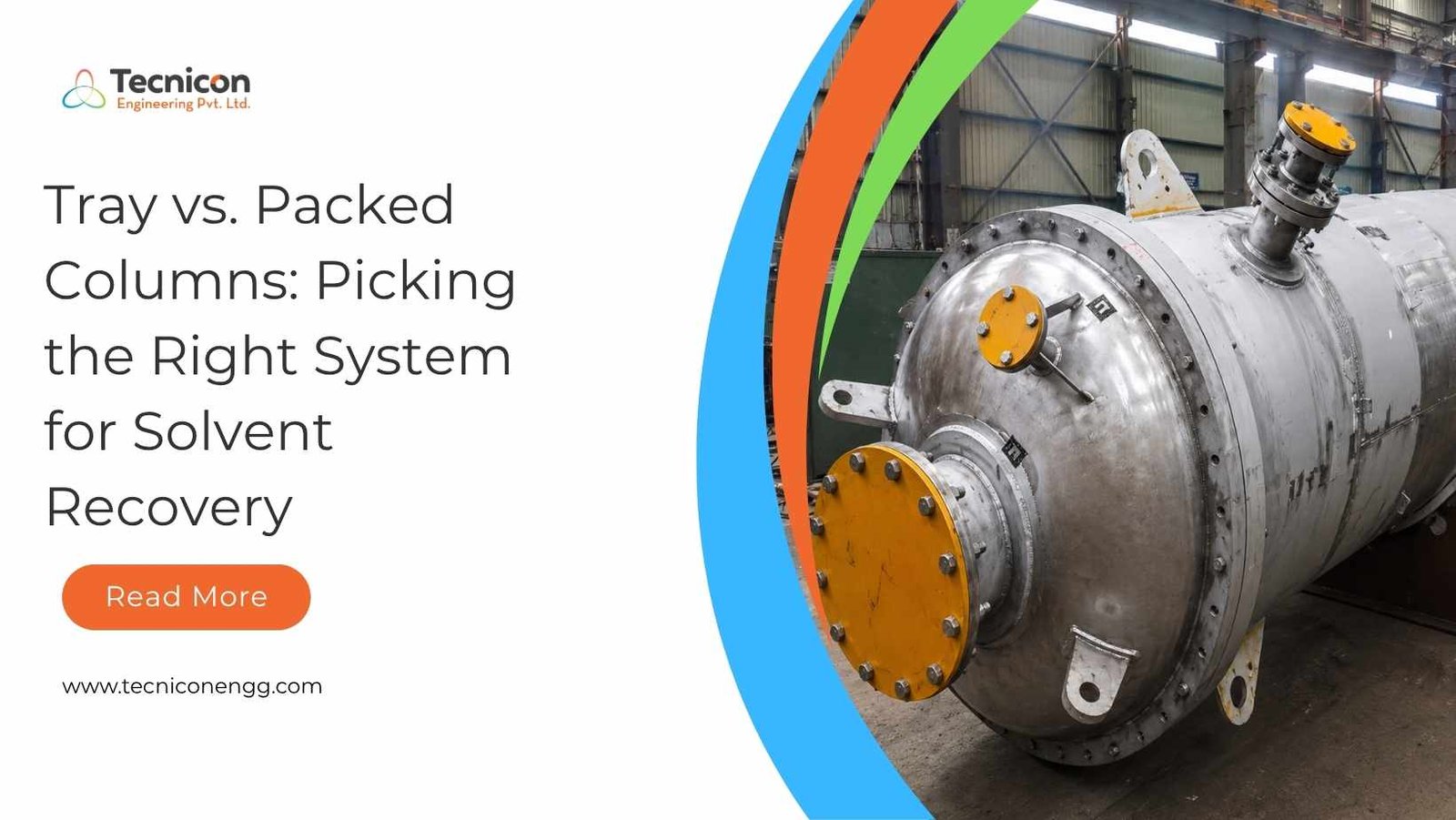
Tray vs. Packed Columns: Picking the Right System for Solvent Recovery
Choosing between a tray column and a packed column for solvent recovery depends on your solvent system, throughput, and how much separation efficiency the process actually needs. Both are proven distillation column designs, but they achieve vapor-liquid contact in fundamentally different ways, which affects everything from pressure drop to how well the column handles fluctuating feed conditions. how tray and packed columns work, where each performs best in solvent recovery, and how to decide which system fits your process.
What Is a Tray Column?
A tray column is a distillation column fitted with a series of horizontal plates, or trays, stacked at set intervals inside the vessel shell. Vapor rises through openings in each tray and bubbles through a layer of liquid held on the tray surface, while liquid flows downward from tray to tray through downcomers. This repeated vapor-liquid contact at each stage drives the separation.
Common Tray Types
- Sieve trays – Flat plates with small perforations that allow vapor to pass through; simple and cost-effective for many services.
- Valve trays – Movable caps over each opening that adjust to vapor flow, giving better turndown across varying loads.
- Bubble cap trays – Individual caps that force vapor through a liquid seal; more complex but effective at low vapor rates.
Each tray acts as a discrete equilibrium stage, and the number of trays required depends on the separation difficulty of the solvent mixture being recovered.
What Is a Packed Column?
A packed column achieves separation differently. Instead of discrete trays, the column is filled with packing material, either structured packing (thin, corrugated sheets arranged in a defined pattern) or random packing (small shaped pieces like rings or saddles poured into the column). Liquid flows down over the packing surface while vapor moves upward through the gaps, creating continuous rather than stage-wise contact between the two phases.
Because the separation happens continuously along the packing height rather than at fixed trays, packed columns are often described using a “height equivalent to a theoretical plate,” or HETP, a way of expressing how much packing height delivers the same separation as one theoretical tray stage.
Tray vs. Packed Columns: Key Differences
| Factor | Tray Column | Packed Column |
| Contact mechanism | Discrete stages via trays | Continuous contact over packing surface |
| Pressure drop | Generally higher | Generally lower |
| Turndown ratio | Good, especially with valve trays | Narrower, more sensitive to flow variation |
| Capacity for high liquid loads | Strong | Can flood at high liquid rates without proper sizing |
| Fouling tolerance | Easier to inspect and clean tray by tray | Harder to inspect; fouling can be difficult to detect |
| Column diameter | Efficient at larger diameters | Very efficient at smaller diameters |
| Retrofit and vacuum service | Adequate | Often preferred for vacuum distillation due to low pressure drop |
| Typical capital cost | Lower for standard sizes | Higher, especially with structured packing |
Separation Efficiency and Pressure Drop
Packed columns typically offer lower pressure drop per unit of separation achieved, which matters significantly in vacuum distillation, a common requirement in solvent recovery where lower operating pressure reduces the boiling point of the solvent and limits thermal degradation of sensitive process fluids. Tray columns generally run at somewhat higher pressure drop, which is less of a concern in atmospheric or pressurized solvent recovery services.
Handling Variable Feed Conditions
Solvent recovery feed streams are not always constant. Batch processes especially may see fluctuating solvent concentration or flow rate between runs. Tray columns, particularly with valve trays, tend to tolerate this variability better, maintaining reasonable efficiency across a range of vapor and liquid loads. Packed columns are more sensitive to flow variation outside their designed operating range and can lose efficiency or flood if liquid loading rises significantly above design conditions.
Fouling and Maintenance
Solvent recovery streams sometimes carry trace contaminants, polymerized residue, or particulates depending on the upstream process. Tray columns allow inspection and cleaning tray by tray, making it easier to identify and address localized fouling. Packed columns, especially with random packing, can be harder to inspect thoroughly, and fouling within the packing bed can reduce efficiency without an obvious external sign until performance has already dropped.
Column Diameter and Space Constraints
Packed columns tend to be more efficient at smaller diameters, since packing surface area per unit volume remains high even in narrow columns. In larger-diameter columns, uneven liquid distribution across the packing bed becomes a bigger design challenge, and tray columns often become the more practical choice at scale.
How to Choose Between Tray and Packed Columns for Solvent Recovery
- What is the required separation efficiency and operating pressure?
Vacuum solvent recovery often favors packed columns for their lower pressure drop. - How variable is the feed?
Batch operations with fluctuating loads generally do better with tray columns and their wider turndown range. - Does the solvent stream carry fouling potential?
Streams with particulates or residue may be easier to manage in a tray column that allows tray-by-tray inspection. - What column diameter is required?
Smaller-diameter columns often favor packing; larger columns often favor trays. - What is the available capital budget?
Standard tray columns are typically less expensive to fabricate than columns with structured packing, though the total cost comparison should include long-term operating and maintenance factors.
Conclusion
Tray and packed columns both serve the same purpose in solvent recovery, separating solvent from a process mixture through repeated vapor-liquid contact, but they reach that goal through different mechanical designs with different strengths. Tray columns handle variable feed conditions and fouling-prone streams with more flexibility, while packed columns offer lower pressure drop and strong efficiency in vacuum service and smaller-diameter applications. The right choice depends on your specific solvent chemistry, feed variability, pressure, and maintenance expectations.
If you’re evaluating column options for a solvent recovery project, working with an experienced distillation column manufacturer can help match the design to your actual process data. Tecnicon Engineering designs and fabricates tray and packed distillation columns in Ahmedabad, Gujarat, for chemical, pharmaceutical, and solvent recovery applications, and can help you determine which configuration fits your operating conditions.