
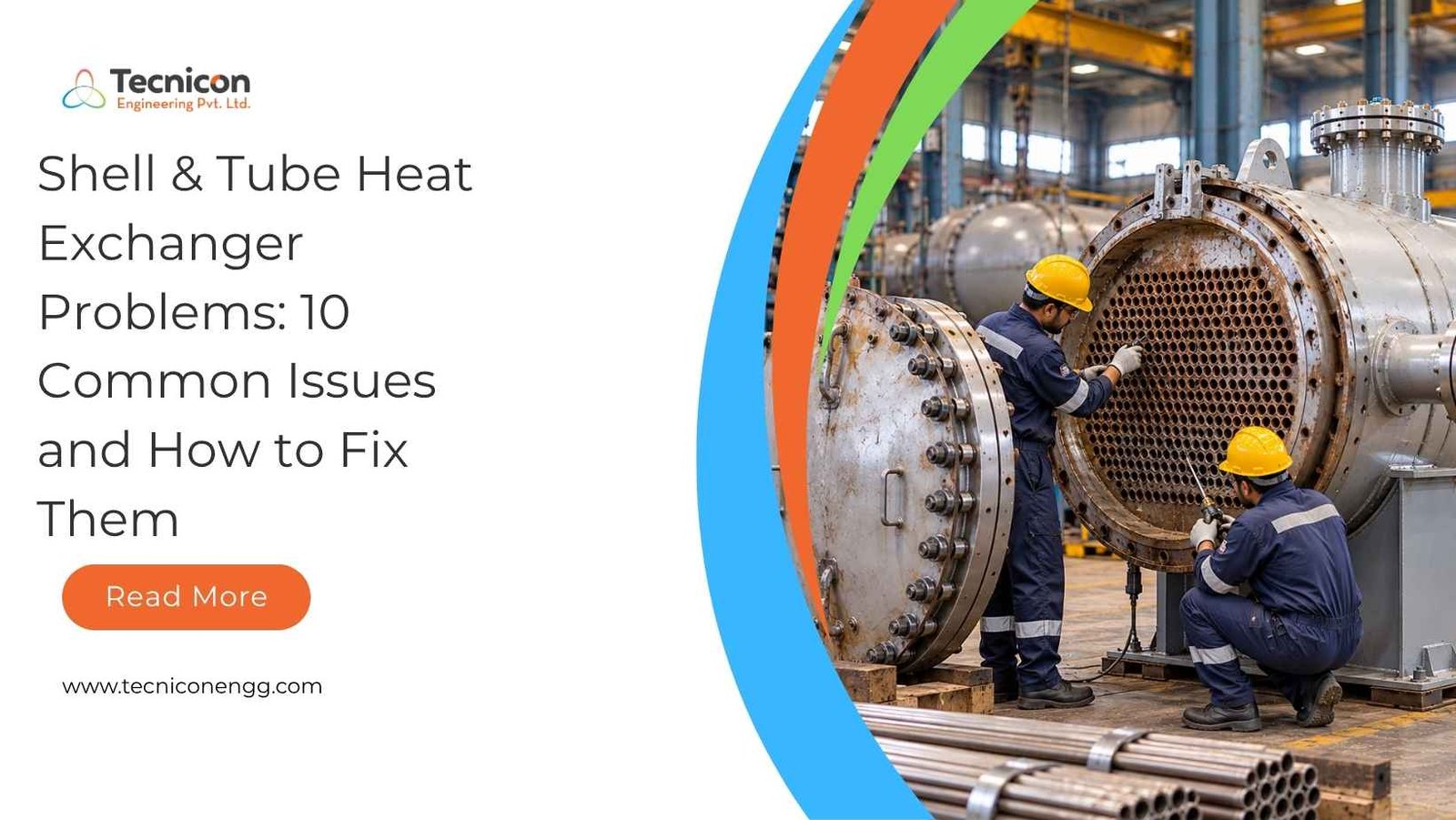
Shell & Tube Heat Exchanger Problems: 10 Common Issues and How to Fix Them
Most shell and tube heat exchanger problems come from a small set of causes: fouling and scaling, corrosion, leakage, vibration, and poor operating or maintenance practices. Each one shows up as a symptom, such as reduced heat transfer, rising pressure drop, or contamination between fluids. Identifying the cause correctly is the key to a lasting fix.
This guide covers ten common shell and tube heat exchanger issues, how to recognize them, and practical corrective steps for plant engineers and maintenance teams.
1. Fouling and Scale Formation
Fouling is the buildup of deposits on tube surfaces. Scale formation, sediment, biological growth, and polymerized products all insulate the tube wall, lowering heat transfer efficiency.
Signs: Falling outlet temperature performance, rising pressure drop, and more frequent shutdowns.
Fixes:
- Clean the tube bundle using mechanical methods, high-pressure water jetting, or chemical cleaning suited to the deposit
- Improve cooling water treatment to limit scaling
- Increase fluid velocity within allowable limits
- Place fouling fluids on the tube side, where cleaning is easier
2. Tube Blockage and Flow Restriction
Debris, scale chunks, or process solids can plug individual tubes. Blocked tubes reduce effective surface area and create flow restriction.
Fixes: Install strainers upstream, clean or rod out blocked tubes, and inspect during shutdowns for debris sources. Persistent blockage may justify a more open tube layout or a design that allows easy access.
3. Tube Corrosion
Tube corrosion occurs when the tube material is not compatible with the process fluid or the utility medium. Pitting, stress corrosion cracking, and general wall thinning are common forms, especially with chlorides.
Fixes:
- Confirm material compatibility with every fluid, including cleaning chemicals
- Upgrade the grade, for example from stainless steel 304 to 316 or a special alloy, where the service demands it
- Control water chemistry and chloride levels
- Use inspection methods such as eddy current testing to track wall loss
4. Shell Corrosion
Shell corrosion is less visible but equally serious, particularly where moisture, insulation, or aggressive shell-side fluids are present.
Fixes: Inspect the shell and nozzles during turnarounds, maintain coatings and insulation, and verify the corrosion allowance in the original design against measured wall loss.
5. Tube Leakage
Tube leakage allows the two fluids to mix, contaminating product or utility streams. Common causes include corrosion, erosion, vibration damage, and thermal stress.
Fixes:
- Locate the leak through hydrostatic or pressure testing
- Plug failed tubes temporarily, keeping track of how many are plugged since each reduces capacity
- Replace the tube bundle when too many tubes are affected
- Address the root cause so the failure does not repeat
6. Tube-to-Tubesheet Joint Leakage
Leaks at the joint between tube and tubesheet often result from thermal cycling, poor expansion, or weld defects.
Fixes: Re-expand or re-weld the joint using qualified procedures, and review startup and shutdown practices. Rapid temperature changes stress these joints.
7. Gasket and Seal Failure
Gasket failure and seal failure cause external leakage at flanges and covers. Causes include wrong gasket material, uneven bolt tightening, thermal cycling, and damaged sealing surfaces.
Fixes:
- Select gasket material for the temperature, pressure, and chemical environment
- Follow a proper bolt tightening sequence and torque
- Inspect flange faces before reassembly
- Replace gaskets whenever the exchanger is opened
8. Flow-Induced Vibration
Excessive shell-side velocity can make tubes vibrate and strike baffles or each other, leading to wear and cracking.
Signs: Noise, localized tube failures near baffles, and unexplained leaks.
Fixes: Reduce flow rate where possible, add or adjust support baffles, or revise the design to lower shell-side velocity. A designer should evaluate these changes, as they affect pressure drop.
9. Thermal Stress and Expansion Problems
Large temperature differences between shell and tubes cause differential expansion. In fixed tubesheet designs, this can overstress tubes, joints, and the shell.
Fixes:
- Avoid sudden temperature changes during startup and shutdown
- Use expansion joints, floating head, or U-tube designs when expansion is significant
- Review operating limits against the original design conditions
10. Insufficient Cooling or Heating Performance
When the exchanger fails to reach target temperatures, the issue may be fouling, but it can also come from incorrect flow rates, air or vapor locking, bypassing through damaged baffles or pass partition plates, or a change in process conditions beyond the original design.
Fixes:
- Check flow rates and temperatures against the design data sheet
- Vent trapped air or gases
- Inspect baffles and partition plates for damage or leakage paths
- Recalculate performance if duty or fluid properties have changed
Why Heat Exchangers Lose Efficiency Over Time
Efficiency declines gradually through fouling, partial tube plugging, and bypass leakage. Low heat transfer is rarely caused by a single factor, so compare current temperature and pressure drop readings with baseline values taken when the unit was clean. A steady drift points to fouling, while a sudden change suggests a mechanical failure.
Preventive Maintenance Practices
A planned maintenance routine reduces most of the problems above:
- Record inlet and outlet temperatures, flow rates, and pressure drop regularly
- Schedule cleaning based on trend data, not only fixed intervals
- Inspect tubes using non-destructive methods during turnarounds
- Keep records of plugged tubes and repairs
- Operate within design limits and avoid thermal shocks
Choosing a Manufacturer or Service Partner in India
Repair, retubing, and replacement all depend on sound design and fabrication. A shell and tube heat exchanger manufacturer in India should provide thermal and mechanical design, qualified welding, tube-to-tubesheet joint expertise, pressure testing, and complete documentation.
Gujarat is one of India’s main chemical and engineering regions, so working with a shell and tube heat exchanger manufacturer in Ahmedabad or an industrial heat exchanger supplier in Gujarat can make inspections, repair support, and troubleshooting visits faster. For chemical plants, ask for experience with similar fluids and operating conditions before finalizing a custom shell and tube heat exchanger manufacturer in India.
Conclusion
Shell and tube heat exchanger problems usually trace back to fouling, corrosion, leakage, vibration, thermal stress, or operation outside design conditions. Careful monitoring, correct material selection, proper cleaning, and sound design prevent most failures and keep heat transfer performance stable.
When a unit needs repair, redesign, or replacement, share your process data and operating history with an experienced engineering team to find the root cause rather than repeating the same fix.