
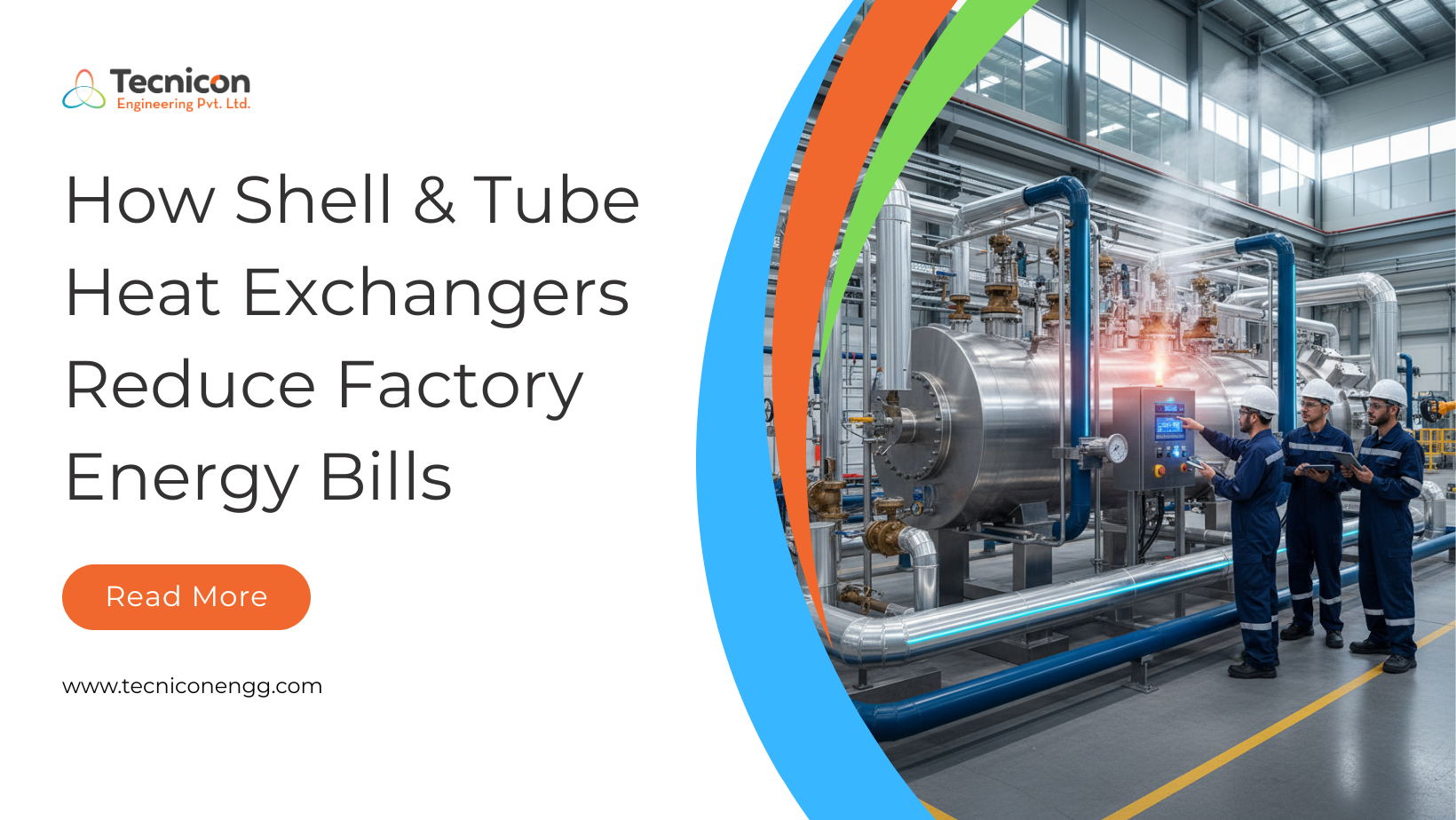
How Shell & Tube Heat Exchangers Reduce Factory Energy Bills
Energy costs are one of the biggest operational expenses for any industrial facility. Whether you run a chemical plant, a food processing unit, or a pharmaceutical factory, heating and cooling processes consume a massive share of your total electricity and fuel budget.
The problem is not just how much energy you use it is how much you waste. In most factories, 30 to 40 percent of generated heat simply escapes through exhaust pipes, cooling water drains, and uninsulated surfaces. That wasted heat represents real money leaving your business every single day.
Shell and tube heat exchangers are one of the most proven and cost-effective solutions to this problem. They recover waste heat, reuse it within your process, and directly reduce the amount of fresh energy your facility needs to purchase. This guide explains how they work, why they save money, and how to choose the right system for your factory.
What Is a Shell and Tube Heat Exchanger and How Does It Work for Industrial Energy Efficiency?
A shell and tube heat exchanger is a device that transfers thermal energy between two fluid streams without them ever mixing. One fluid flows through a bundle of tubes, while the other flows around those tubes inside a cylindrical shell. Heat passes through the tube walls from the hotter fluid to the cooler one.
In industrial settings, this mechanism becomes extremely valuable. Instead of dumping hot exhaust or spent process fluid down the drain, factories use heat exchangers to capture that energy and redirect it preheating incoming water, warming process chemicals, or conditioning air before it enters furnaces.
Counter Flow vs Parallel Flow Heat Exchanger Which Saves More Energy?
The direction fluids travel inside the exchanger makes a measurable difference in thermal efficiency.
In a counter flow design, fluids move in opposite directions. The cold fluid exits near where the hot fluid enters, which maximizes the temperature difference across the full length of the exchanger. This configuration achieves up to 95% heat transfer efficiency and is the preferred choice for most industrial energy-saving applications.
In a parallel flow design, both fluids enter from the same end and travel in the same direction. The temperatures of both streams converge toward the outlet, which limits how much heat can actually be transferred. This design is easier to control in certain situations but delivers significantly lower efficiency compared to counter flow.
How Heat Exchangers Save Energy in Industry The Real Mechanism Behind Cost Reduction
The core principle is waste heat recovery. In a typical unoptimized factory, thermal energy is consumed twice once to generate heat for a process, and again to cool it back down before disposal. A shell and tube heat exchanger short-circuits this cycle by capturing heat mid-process and reinvesting it elsewhere in the facility.
Waste Heat Recovery System for Industrial Plants Where the Big Savings Are Found
Flue Gas Recovery: Hot exhaust gases from boilers and furnaces typically leave at 250 to 400 degrees Celsius. A heat exchanger captures this energy and uses it to preheat combustion air or incoming feed water, directly reducing fuel consumption.
Cooling Water Reuse: Hot cooling water discharged from reactors or compressors carries significant energy. Rather than chilling it mechanically, routing it through a heat exchanger to warm another process stream cuts chiller load dramatically.
Steam Condensate Recovery: Steam condensate at 80 to 120 degrees Celsius is frequently wasted. Recovering and reusing it reduces boiler make-up water demand and the energy required to reheat fresh water from ambient temperature.
Process-to-Process Transfer: Directly transferring heat from a hot outgoing stream to a cold incoming one without involving the boiler at all is the most direct form of energy saving in a factory and reduces heating demand at the source.
Industry data consistently shows that plants implementing a properly designed waste heat recovery system reduce total energy consumption by 20 to 40 percent, with measurable reductions visible from the very first billing cycle after installation.
Shell and Tube Heat Exchanger Design What Determines Efficiency in Your Factory?
Not all heat exchangers deliver equal savings. Thermal energy transfer efficiency in industrial systems depends on several critical design parameters that a qualified manufacturer will evaluate before recommending a solution.
Types of Shell and Tube Heat Exchangers Choosing the Right Configuration
The fixed tube sheet design is the most economical option and works best for clean, non-corrosive fluids where tube bundle removal is not regularly needed.
The U-tube design handles high pressure and high temperature applications well, making it common in oil and gas and power plant environments.
The floating head design is preferred when frequent mechanical cleaning is required, such as in food processing or pharmaceutical manufacturing where hygiene standards are strict and fouling is common.
Key design factors that determine overall heat transfer efficiency include tube diameter and wall thickness, baffle spacing and cut angle, shell diameter, number of tube passes, and the thermal conductivity of tube materials, which are typically stainless steel, copper alloy, or titanium depending on the process fluid chemistry.
Industry-Specific Heat Exchanger Applications Who Benefits the Most?
Shell and tube heat exchangers are used across virtually every major industrial sector. Each industry has unique process conditions that require purpose-engineered solutions.
In the chemical industry, they are used for reactor feed preheating, solvent recovery, and cooling exothermic reactions. Properly designed systems in this sector typically deliver 25 to 40 percent energy savings.
In the oil and gas industry, applications include crude oil preheating, gas processing, and refinery heat integration. Energy savings in this sector commonly reach 30 to 45 percent.
In food processing plants, heat exchangers handle pasteurization, clean-in-place water heating, and juice or syrup cooling. Stainless steel SS 316L construction is standard to meet food safety requirements.
In pharmaceutical manufacturing, they are used for purified water heating, reactor jacket cooling, and solvent condensation, with sanitary floating head designs preferred for cleanability.
In power plants, feedwater heating and condenser service are among the most critical applications, with some configurations delivering up to 50 percent reduction in supplemental heating energy.
In HVAC systems, shell and tube exchangers support chilled water production, district cooling networks, and heat pump integration across large commercial and industrial buildings.
Industrial Energy Efficiency Solutions Calculating the Real Cost Savings for Your Factory
When evaluating the price of a shell and tube heat exchanger in India, the upfront purchase cost is only part of the picture. The correct measure is total cost of ownership over a 10 to 15 year operational life.
Consider a medium-scale chemical plant spending ₹20 lakhs per month on fuel and steam energy. If a heat recovery system captures 30 percent of wasted thermal energy, that translates to ₹6 lakhs saved every month, or ₹72 lakhs per year. A high-quality custom heat exchanger system for a plant of this scale typically costs between ₹15 and ₹40 lakhs depending on design complexity, materials, and operating pressure requirements. In many real-world cases, payback is achieved in 3 to 7 months.
The shell and tube heat exchanger market in India has become highly competitive as domestic manufacturing has matured. Partnering with an experienced industrial heat exchanger manufacturer in India rather than importing equipment can reduce capital cost by 20 to 35 percent while also ensuring faster delivery, easier access to spare parts, and local service and maintenance support.
How to Choose the Right Energy Efficient Heat Exchanger System for Your Factory
Selecting the wrong heat exchanger can be worse than having none at all. A poorly matched unit can cause excessive pressure drops, accelerated fouling, unplanned shutdowns, and disappointing energy savings.
What to Ask Your Custom Heat Exchanger Manufacturer
Before specifying any unit, your manufacturer should conduct a thorough process audit covering the following areas: inlet and outlet temperatures of both fluid streams, volumetric flow rates, allowable pressure drops on both sides, fluid corrosivity and fouling tendency, cleaning and maintenance requirements, available installation space and nozzle orientation constraints, and applicable regulatory standards such as ASME, IBR, or PED.
A manufacturer who skips this audit and offers a standard catalogue product is not optimizing for your energy savings. Demand a formal thermal design calculation and a guaranteed minimum heat duty stated clearly in the purchase agreement.
Conclusion
Shell and tube heat exchangers are not a new technology, but they remain one of the most reliable and financially rewarding investments an industrial facility can make. By recovering heat that would otherwise be wasted, they directly reduce fuel consumption, lower electricity bills, cut carbon emissions, and improve the overall efficiency of your manufacturing operation.
If your factory is spending heavily on energy and has not yet evaluated waste heat recovery, a shell and tube heat exchanger system should be at the top of your next capital planning discussion. The numbers, as thousands of plant managers across India have already discovered, speak for themselves

Kishan Patel is the Founder & CEO of Tecnicon Engineering Pvt. Ltd., specializing in manufacturing advanced process equipment for industries like chemicals, pharmaceuticals, and petrochemicals. He is passionate about innovation, quality engineering, and delivering reliable industrial solutions.